
The learning fields for baseball of my youth in Cape Girardeau, Missouri, in the 1960’s were the sandlots, back yards, and other more official places like the north Minor League diamond in Capaha Park, and the Little League diamond in Arena Park. Looking back can be tricky. The memories I have retained from those days are mostly pleasant, but not always to be trusted.
What memories can you trust? There are certain visceral details like the sights, the sounds and the smells. Visual memories like the gritty concrete dugouts, the lights, the fresh lime of the base paths, the shine on the new baseballs and the dust clouds stirred up by the rubber cleats worn by earnest young ballplayers, doing their best. The sounds of the game, most urgently the constant razzing of “no batter, no batter, no batter, no batter!”, and the odd “hum babe!” when encouraging your pitcher. Did we really think that chatter was effective? The distinctively unmistakable one-of-a-kind sound of a wooden bat striking a tightly wound leather baseball. Can you hear it? And finally, the smell of sweaty guys in hot flannel uniforms as we crowded into the dugout, and the distinct aroma of leather baseball gloves, with a hint of Rawlings’ Gloveoleum, a glove conditioner. Yes, I think we can trust those memories.
Details of successes or failures in the actual games? These memories are the tricky ones. I do remember that I played for the Little League Yankees for four years with varying degrees of success. I loved the game enough to want to come back each year and to try to get better.
So, I decided to go back in time. I did a bit of research. The local newspaper, The Southeast Missourian, in our town documented both our Minor League and Little League games in a diligent and steadfast manner. Thanks to Google News Archives, on the Missourian’s link, you can find the results, not to be disputed, even 50+ years later. The articles about these games (including all of the other older leagues) are mostly based on the coach’s scorebook and a short conversation between the coach delivering the results and the sportswriter. These accounts of the games would include box scores. Any fantasies one may have had about dominating the league, or notions of being a superstar are reduced to hard truth. I looked at a number of digitized sports pages spanning the early to mid-1960’s with great interest, not only for my own exploits, but those of my contemporaries. It was enlightening.
Little League had two divisions: American and National, and the team names were true to the same designations. There was no interleague play. American League teams were the Yankees, Twins, Indians, Athletics, Red Sox, and Tigers. The National League had the Dodgers, Cubs, Mets, Giants, Braves and Cards.
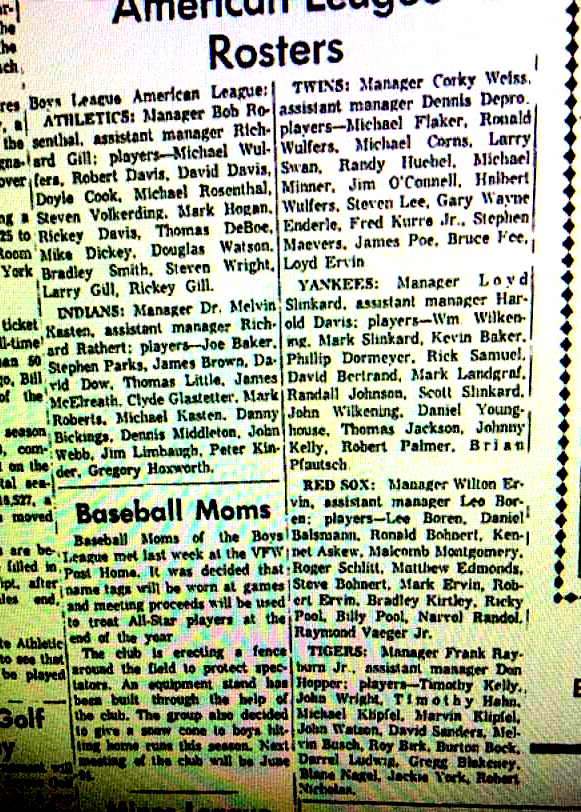
Here are some of my observations, in no particular order:
- Some of the scores could be football scores. I think of the patience of our coaches to sit and witness those long innings, and it warms my heart. And yes, I would coach in these age groups myself years later, and know first hand what that can entail. One year my friends Troy Vieth and Brian Pfautsch and I coached the Little League A’s while we were in high school. It was a fun season in which we won the AL crown but lost in the Championship. Much later, Tom Dohogne and I had some great adventures when we coached our sons together on various teams in the Cape Youth League. Finally, Mike Dunaway, Kevin Ford and I coached a Cape based traveling team (including our sons) of 12 year old’s called the Astros. More on those experiences at another time.
- There were no-hitters. On any given day, any above average pitcher could totally dominate. Sometimes, pitchers are just “on”. This can happen at any level in baseball, of course. Little League no-hitters happen when adrenaline, confidence, and good luck all strike a 12 year old kid at the same time.
- The names of the kids I played baseball with in the 1960’s came rushing back into consciousness, and I was surprised at how many I remember, along with the ability to picture these guys in my head.
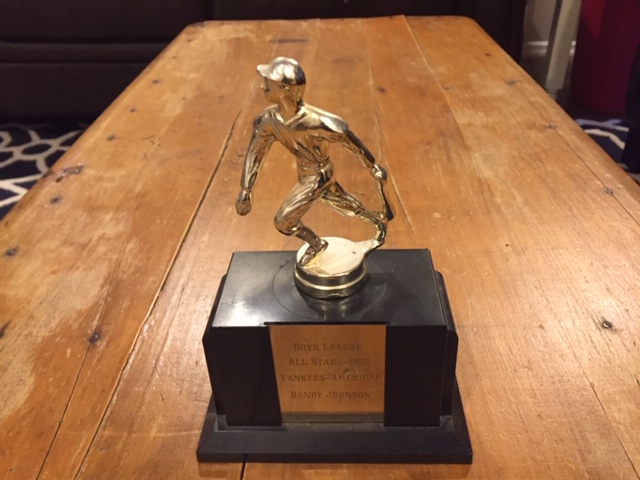
- The stud pitchers in 1966, my last as a Little Leaguer, were Danny Eaker, Bob Ervin, Brad Kirtley, Terry Reynolds, and Roy Birk. I didn’t make this cut, although I did make the All Star team in 1966, evidenced by a plastic trophy I still own to this day. As to Danny Eaker, he was a tough competitor that pitched in Little League for at least three years at a very high level, and I never saw a box score with a bad outing from this kid. My memories of Bob Ervin were that he was a cool customer that pounded the strike zone relentlessly. The Red Sox had two stellar pitchers in Ervin and Kirtley, which should explain why the Red Sox were the class of the American League.
- The teams that won consistently were those that had the solid pitching and catching. This doesn’t sound like rocket science, I agree, but it was especially true at this age. As to hitters, there were usually only 2 or 3 really good ones per team. It was walks and errors that usually beat you.
- I can’t always remember what I had for lunch on a given day, but the long ago memories are still powerful from my baseball youth: I can still name a bunch of my teammates over the four years I played on the Yankees. Here is an incomplete but accurate list: Mike “Sand Dog” McKinnis, John and Ben Stafford, Alan Wills, Doug Glenn, Kenny Baker, Nick Powers, Mike and Bill Wilkening, Dan Younghouse, David Bertrand, Mike Uhls, Mickey Palmer, Brian Pfautsch, John Kelly, Rick Samuel, Mark and Scotty Slinkard, Mark Landgraf. Our manager Loyd Slinkard was a very kind man of few words and a big heart.
One of my above mentioned teammates, classmate Rick Samuel, became a saxophone player of some renown. Rick and other talented musicians had created something very special at Central High in the form of a fantastic stage band. He and two friends, Phil Cloud and Derek Proffer, died in the early fall of our senior year in high school in a tragic auto accident. Rick and his friends were driving to a music concert at SIU in Carbondale, IL, and a truck crossed the center line causing a head on collision. Another classmate, Don Wilson, miraculously survived the crash. The thought of these friends on a carefree outing and in an instant, utter horror, is life-changing. End of innocence? For me and the rest of my classmates, it was. For our Yankees, Rick played a solid center field, and while tracking flies, had the habit of holding his arms straight out wide like wings while waiting for the ball to arrive. I can still visualize this from the pitcher’s mound. Wow, the things you remember. Rest in Peace, Rick.
 Little stories from the big adventure
Great story about LL baseball in Cape. Would enjoy sharing some “older” memories on the subject sometime.
LikeLike
That would be great Dale! We need to have that lunch or dinner or coffee we talked about.
LikeLike