
In the spring of 1974, the SMU Baseball Mustangs made the 195 mile drive to Austin to play a three game series against the University of Texas Longhorns—perennial champs of the Southwest Conference. My first experience pitching against them the previous year as a freshman in Dallas did not go well. In fact, I had helped Bobby Keith “Zonk” Moreland, then a freshman infielder for the ‘Horns, win SWC Player of the Year. Zonk never thanked me. I relieved against Texas in the middle innings in the 1973 season, and remember little else except this: Moreland hit a poorly located slider (a pitch that may have actually hit him in the stomach if he didn’t swing) for a grand slam, over the fence, across the street, all the way to Moody Coliseum with one hop to the front of the building. Somehow the ball stayed fair, a tribute to his quick bat and his strength. I can still see his eyes bulging out as he got maximum compression, bat-on-ball. He had the quickest hands I had ever faced (with the possible exception of Steve Volkerding, one of my high school teammates). Although all the runs scored that day were not off of me, I remember the grand slam, and a 22-5 final score. Prodigious? It was, and with a wooden bat no less. Metal bats came out the next year in 1974. Subsequent encounters with Mr. Moreland over the next couple of years would not involve hanging sliders. Keith would later play catcher and outfield for the Phillies, Padres and the Cubs. He is currently the voice of the Baseball Longhorns on the Longhorn Network.

So the next year, my sophomore year, we played the ‘Horns in Austin. The Longhorns had a brand new stadium planned for their campus that opened in time for the 1975 season, but in 1974 we played them at their historic home ballpark, Clark Field. Clark Field was built in 1928, and legend has it that Lou Gehrig hit a 550 foot home run to left center there in a barnstorming game in the 30’s. The unique feature of Clark Field was its outfield configuration.
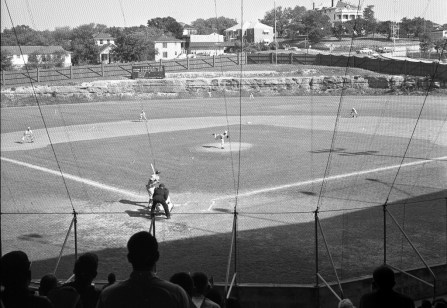
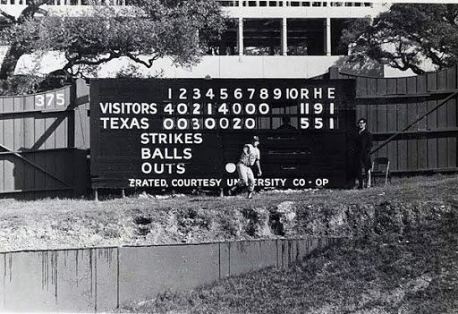
The outfield was dominated by a limestone wall. The field may have been built on a quarry property, because this wall was about 30 feet tall in centerfield, and tapered toward left field, eventually to a small grassy sloping knoll at the left field foul line. That would have been unusual enough, I guess, but there was also a grass shelf beyond the cliff in left field, known as “Billy Goat Hill” that was in play. The fence was beyond the shelf. There was eventually a path worn near the mid-point in left center. Speedy outfielders, accustomed to the field (read home team) could gauge the flight of the ball and run up the path, and relay the ball into the infield quickly. My teammates told the story of our recently graduated star hitter Jon Astroth who had been thrown out at home on a ball he hit to the shelf two years earlier. Here is a picture taken from an earlier year–the score shown is not an SMU-Texas score, unfortunately:
This 1974 version of the Longhorns would finish 54-8, and end with a College World Series berth, frustrating its primary Southwest Conference rival, Texas A&M, once again. Back then, the NCAA did not limit athletic scholarships like they do today. A wealthy school like Texas, if they chose to do so, could afford to sign a bunch of baseball athletes and keep them on an expanded roster. The story going around back then was that Texas offered scholarships to enough good Texas high school players each year just to create an intense competition for starting positions. Even if some players they recruited didn’t get to play much, at least it kept those guys from competing against them. They were a well oiled machine.
I had been pitching pretty well prior to the 1974 Longhorn series, and was at the time one of our conference starters. I had the seven inning game, the first of a double-header on Saturday. Prior to my start, I don’t remember being nervous. I do remember being pretty relaxed–maybe from low expectations? The Longhorns had beaten us badly the day before 18 to 3. I also remember being very tired for reasons that are not important to this story, but may have involved Lone Star long necks served in ice buckets consumed in a large on-campus disco called the Drum the night before. Also, why we thought it was a good idea to wear our letter jackets to the Drum, I will never know. Also, if Tino Z would have just for once kept his mouth shut….I digress.
Some games that I have played in my life are vague memories. Some, like this one, on the other hand are vivid and are preserved in my mind in more than one of my senses. I can still feel the temperature of this game on my skin, the angle of the sun at game-time, and can hear the kazoos. Yes, the kazoos. Large groups of students actually got PE class credit for coming to the games at UT, and they would distribute and play kazoos to entertain themselves between innings.
My pitching stint got off to a good start. I was not throwing particularly hard that day, but every pitch was moving, moving a lot. I’ve had better stuff before, but somehow the ball felt unusually light in my hand that day.
Our opposing pitcher for that game would be senior Rick Burley. We scored first, and were playing well enough to carry a 4-2 lead into the bottom of the 4th. Man, we wanted to win that game. SMU had not beaten Texas since, well, almost never. As for me, I was cruising. Sometimes when you are pitching at a lower velocity, you are instinctively more precise and careful. Meanwhile the Longhorns were overanxious and were swinging at everything. Maybe they remembered me from the year before? My fastballs were tailing away from the right-handed batters, and the lefties were getting a steady dose of curveballs.
The Longhorn leadoff batter was a guy named Terry Pyka. Pyka led the NCAA that year in bruises; that is to say, getting hit by pitches. In fact, I hit him more than once that game, one time with a ball that may have actually been on the inside corner. He had a knack for crowding the plate, and spinning away from inside pitches in such a way that his hip would sometimes stick out just a bit over the plate. He was notorious for this in the SWC. We argued about him trying to get hit intentionally, but also knew we were not going to get that call in Austin. At any rate, at the end of the 4th, the Longhorns had just a few hits, and I came off the mound after the third out pretty jazzed about everything. Pyka had been stranded on first, and he trotted over to intercept me on the way back to the dugout. Nose to nose, he calmly said these words to me now etched in my mind forever: “Lefty, you are pitching a pretty good game, but you are going to remember this as the time you almost beat Texas”. The man, besides being a great leadoff man, fashioned himself to be some kind of Nostradamus.
The game continued in the Mustangs’ favor into the bottom of the sixth. Our lead remained 4-2, and they still hadn’t really hit the ball hard off of me. The kazoos continued their obnoxious droning, and I noticed that they were now continuing during play while we were in the field.
I was tiring, and the Horns picked up a couple of runs in the bottom of the sixth. It was now 4-4, and with the bases loaded and two outs, Finley replaced me with Jim “Hollywood” Warren. Hollywood did not throw hard, but at times he could frustrate good fastball hitters with his knuckleball and had been pitching pretty well for us in relief. He slammed the door in that inning, and we were still tied 4-4.
Jim Moffit, our right fielder was swinging a torrid bat, and put the Ponies ahead again in the top of the seventh inning with a solo homerun. He seemed to own Jim Gideon, who had come in to pitch in relief of Burley and Robert Cuellar. Gideon was their ace, and was scheduled to start the second game of the doubleheader. They were going all out to win this one. When they came to bat in the bottom of the seventh, the Longhorns suddenly quit swinging at everything and mysteriously the plate seemed to shrink right before our eyes. Hmmm. Hollywood was able to get two outs, but ultimately the bases were loaded. We just needed one more out for a 5-4 win. Just… one… out.
The next batter, Mickey Reichenbach, hit a towering fly ball into left. Our left fielder is Mark “Hambone” Hammond, probably our most sure-handed fielder and maybe the best athlete on the team. He sees the ball well off the bat and with ease retreats toward the left field foul line, intently tracking the ball all the way. That is going to stay in the park! Mark has turned back to face the infield, his eyes never leaving the ball. We have got this one. We did it. Wow. This will be one for the memory bank. This will be a game to remember on some bleak winter day, sitting at my desk in my office, when things aren’t going so well. Mark now drifts back a little more…wait…Mark’s spikes catch a tiny bit on the little grass knoll–remember the knoll? He proceeds to sit down on his backside, hard. He stabs at the ball in vain. The ball falls sadistically in fair territory just out of his reach for a walk-off two run single. A Clark Field-Billy Goat Hill single. Game over, 6-5 Longhorns.
Terry Pyka: leadoff man and soothsayer. Not mean. Not cruel. Just dead solid correct
 Little stories from the big adventure
Randy, thanks for sharing this story.
LikeLike
thanks John!
LikeLike
I have noticed you don’t monetize littlestoriesfromthebigadventure.com, don’t waste your traffic,
you can earn additional bucks every month with new monetization method.
This is the best adsense alternative for any type of website (they approve all sites), for more details
simply search in gooogle: murgrabia’s tools
LikeLike