The Battle

Prologue:

Cedar Lake, located in Millersville, MO was built by my grandparents, Truman and Eula Statler, on their farm with assistance from the Missouri Department of Conservation in 1948. It was part of a state assisted flood control-watershed program.  Truman and Eula were “Pappy and Mammy” to us. Spring-fed and healthy, this lake of 40 acres became a popular day-trip for serious fishermen all around Cape Girardeau and Bollinger Counties. For a dollar, you could fish all day, or as the sign on the boathouse said, one dollar gave you “trespassing rights” for the day. The farm was also prosperous, with bottom land that lay along the Upper Whitewater Creek for feed corn, and gentle sloping hills ideal for cattle grazing. It was a great place to settle in and spend the day. In the lake’s heyday, my grandparents even seasonally ran a restaurant called “The Snack Shack” for their patrons.

Since this was located a mere 15 miles from our home in Cape Girardeau, we in the Johnson family were lucky enough to enjoy the lake and farm fairly often, to fish, or swim in the Upper Whitewater Creek at the deep pool bluff, a short walk from the boathouse, a spot known by all the locals as “the swimmin’ hole”. My personal memories include several times spending a week with my grandparents at the farm by myself;  helping Pappy feed the calves early in the morning, bouncing across the corn fields with him in his pickup truck, playing in the hayloft, helping with customers at the boathouse, and taking trips to Fredericktown to buy minnows for bait. Other perfect memories there: dumping peanuts in the bottles of Dr. Pepper–the perfect salty-sweet concoction for a summer afternoon treat, eating ice cold orange pushups from the boathouse deep freeze, a few snake encounters (mostly black snakes and king snakes) with assurances from Pappy that “they won’t bother you if you don’t bother them”. I remember having to hold my breath and wrinkle my nose while using the outhouse next to the lake. I learned to handle a rowboat there. Here at the lake, we were loved unconditionally; and perhaps for the first time we were trusted to be independent and safe. I still wonder at how hard my grandparents worked to keep that place up and running. Pappy dutifully bush-hogged and mowed and trimmed the grass around the lake and Mammy kept the boathouse fully supplied and kept the books, and they did everything in between, in addition to running the farm.

The Battle

One family day trip to the lake in the middle of summer stands out in my mind. I was about five or six, and we had made the trip over to Millersville in our powder blue Chrysler station wagon, with me in the center seat in the back. Realize that this was before air conditioning was common in cars. I must have griped the whole way there, and I was determined to call a window seat for the return trip.

At this time, we were a family of six, and I was the youngest of the four kids with an older brother, Larry and two older sisters, Lea and Beth. Wayne, Bryan and Tina came along later. Birth order theory, at that particular time, would have rightfully pegged me as “the mascot”. Mom and Dad spent much of their time as peacemakers, as was typical. They were the impartial mediators, judges and jury, and their laid-back demeanors belied the fact that they were no pushovers.

After spending the day at the lake, and as we gathered our stuff and headed for the car, I called a window seat. Larry quickly responded. “Sorry, Randy–Lea and I already called the window seats.”

“When did you call them? I didn’t hear you!”

“You weren’t here when we called it. Sorry, the window seats are already taken.” (I believe he audibly snickered at this point).

“That’s not fair! You can’t call it that far in advance!”

At this point, my Dad, with a playful bent and trying to help by easing the tension, interjected this statement, which started a dizzying chain of events: “Randy, you can sit anywhere you want…..as long as it’s not by a window”.

At first I fell for it. “I can?”. Then the reality set in. I remember being pissed at that point. Then without thinking it all the way through, I blurted out, “OK, then I’m riding on TOP OF THE CAR.” That caught Dad a little by surprise, but with a sly grin, he nodded and said OK. The battle of the wills was on.

As the ‘reality’ of a 15-mile ride down the highway back home to Cape on the top of the blue Chrysler started to register in my mind, I began thinking about practical things like: what was I going to hang onto, and how to breathe in the face of what would be a strong impact of the wind. I eyed the car suspiciously, and found a narrow band of metal, perfect for gripping near the front just above the windshield. Spread eagle on my stomach seemed to be my best bet. I also thought that the best way to breathe in the face of the strong wind was to turn my head away toward my shoulder. This also would keep me from inadvertently inhaling any bugs. OK, I think I have this figured out. I’m ready, let’s go!

I began to get chided by my siblings about my decision, but I explained that I was doing this with Dad’s blessing, thankyouverymuch. I don’t specifically remember this, but in retrospect I’m sure I got the wide-eyed incredulous looks from everyone, as in “What is wrong with this boy?”

As the rest of the family loaded in the car, I climbed up on top, lay down on my stomach, dug my fingertips into the strip of metal, turned my head and closed my eyes. Wow, this is really happening, I thought.

Dad slowly backed out, slowly turned and pointed the hood of the car down the gravel road. Then, it was he who blinked first. Suddenly, his door cracked open, and he yelled “GET IN THE CAR!!”. He sounded a little peeved. What? I obediently, although dejectedly, scampered inside—grumpy and back where all of this started, in the middle seat–unaware at the time that I had actually won this battle of wills with Dad.

177

Another visit to the lake in an earlier time. Top row: Pappy, Mammy, Randy, Mom. Bottom row: Lea, Beth and Larry.

Epilogue:

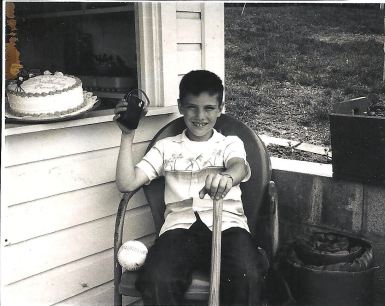
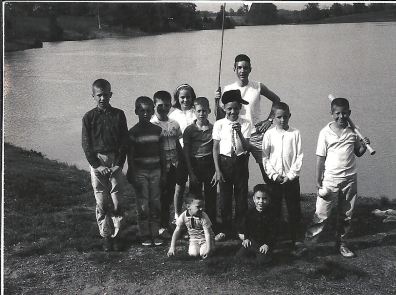
One other vivid memory of Cedar Lake was my 11th birthday, which we celebrated out at the lake. On or about May 3, 1965, we hosted a few of my fifth-grade friends and classmates for a day of fun at the lake. We had a great time, and even managed to play a ragged game of baseball in the meadow below the dam. We didn’t have bases, so we used dry cow patties instead. Others fished and explored the lake in rowboats. Then this happened: Pappy and Mammy were at the end of the dock cleaning fish. We had all gathered around, ostensibly to view the carnage of fish guts. When this task was completed, Pappy pushed the remaining fish body parts into the lake, off the end of the dock. We then ran off to do whatever was next. Unbeknownst to us, my little brother Wayne stayed behind to peer over the edge to get another look at the fish guts, and fell in. The water was deep at this end of the lake, and Wayne was not yet a swimmer. My best friend Jimmy Limbaugh, for reasons no one knows, maybe with the help of some divine intervention, went back, jumped in and fished Wayne out. He saved my brother’s life, plain and simple. Believe in angels? I do, and this one changed all of our lives, and made this day a pleasant memory.
018 (2)

My birthday haul included an awesome transistor radio, a new bat and a sleeping bag.
001 (3)

Left to right, Mike Uhls, Mike Roth, me, my sister Beth, Greg Best, Narvol Randol, Jim Limbaugh, and Rob Shoss.  Older brother Larry in the back, and younger brothers Bryan and Wayne in the front.

Pappy and Mammy sold the lake in the late 1960’s, when the upkeep became too much for them. We all lamented the decision, but we also knew it was for the best. Subsequent owners of the farm have kept Cedar Lake as a private lake. It is still beautiful, but its look has changed immensely while nature, trees, and long grasses have slowly taken over. Even the once prominent cedar tree groves are obscured. The “no trespassing” sign is to be taken seriously as I found out one day a few years ago, while taking pictures. I now know to ask permission at the main house. ‘Pappy’s grandson’ still has some status.

CIMG1301 - Copy

The Paradox

Baseball is a very unique sport. Many have written eloquently about its attributes.  There are routines and traditions. The games themselves ebb and flow at an easy and beautiful pace.  The ardent fan has this pace infused in his or her essence. You watch the game and if you are paying attention, the game nudges you along with it. The pace of play is controlled entirely by its participants. It is rarely frenzied or chaotic. These are attributes of baseball that give real baseball fans comfort.  Since baseball has no time clock, there are few frantic, spastic, or frenzied plays trying to beat the clock. And yet interspersed throughout, there are daring, acrobatic, graceful and sometimes violent plays that happen at unexpected times. In games that do come down to the wire the anticipation builds to a crescendo and the fans’ excitement is shared intimately with the players.  In big games, these plays become a part of baseball’s legends. There is a rule book. The umpires are the arbiters of the rules.

Rules have been created and amended throughout the history of baseball for many reasons: to keep the game moving along at its graceful pace, to keep players from cheating to gain an unfair advantage, to protect players from unnecessary injury, and finally, in general, to maintain the integrity of the game.

If you study the history of the game, you find that competitive baseball players have always sought a ‘competitive edge’ to help their teams win. Some might call them cheaters. I can’t argue with that assessment. It has happened in every era: sharpened spikes, emery boards to scuff baseballs, quick-pitches, spitballs, pine tar, hollowed bats, amphetamines, and more recently growth hormones and steroids, to name a few. The infield fly rule was created to keep players from intentionally dropping a pop-up to get a double play. There is even a rule that keeps you from stealing first base from second base. Yes, really. Apparently, a base runner in years past was doing this illogical activity to distract the pitcher, and they created the rule to stop it. Even with all of this history, the rule book still cannot address every crazy situation that happens on the field. Hence, the umpires interpret and enforce the rules as best they can.

Playing the Baylor Bears in Waco was always an adventure. The fans were noisy and mischievous. They really got a kick out of our SMU Coach Finley and he in turn would ham it up with them. When Finley walked out to the mound or to third base to coach, the fans would yell “HUP, HUP, HUP, HUP” on every step, until he came to a stop, at which time they would yell in unison “WHOOAAA”. Once, Coach Finley marched over to the third base coaching box to the chanting and instead of stopping he slowed a bit-then continued-then slowed-then continued until he finally stopped. The crowd stayed with him every step and when he finally stopped and doffed his cap and bowed, they gave him a standing ovation.

There was an old man with a prosthetic nose in Waco that started yelling at Coach Finley when he was a half-block away from the stadium. I wish I knew the story behind this, but for some odd reason he would yell “Finley-nose Finley! Finley has got a Finley-nose!” He alternately yelled that and “You aren’t Mustangs, you’re nothing but a bunch of sway-back mules!” That old guy was a hoot, and appeared old enough to have seen Finley play football in the 1930’s. Great stuff.

Waco was the site of the famous Jeff Sage “I’ll be back!” quote, long before Arnold Schwartzenegger ever read that from a script. In my senior year, 1976, Waco was the site of a man-made rainout using the sprinkler system a la the movie Bull Durham, resulting in a Saturday triple header. It was also the site of the infamous “That’s Landsmann’s beer, Coach” incident my senior year. All of these are stories for another time.

So, we played Baylor in Waco my sophomore year. As I recall it was a pretty good series. The Baylor Bears took 2 out of 3 from the Mustangs that year. While most of that series remains a bit hazy, one particular play will always be stuck in my memory:

We were in the field, and the bases were full of Bears. There were no outs, and Baylor was poised to break open the game. The Baylor hitter slashes a line drive over third base. The ball was really smoked, and it looked to everyone in the park like a bases-clearing double. The Baylor coach at third base was so sure the ball would rattle around in the corner, that he sent the runner on third home and was waving the runner on second around third base toward the plate.

Our fleet left fielder, Mark “Hambone” Hammond had a better idea. Hambone, originally recruited from Port Arthur to SMU as a wide receiver, was a good athlete, and not afraid to get his uniform dirty. He showed his good instincts by getting a tremendous jump on the ball. In motion with the crack of the bat, he sprinted hard toward the line. To the astonishment of everyone except likely Mark himself, he dove headlong and snatched the ball inches before it touched the grass, and deftly bounced up, ball in glove in a triumphant pose. The base ump, hustling on the play, sees the catch and holds his right fist up, still running toward Mark.

The Bears are stunned. The runners, as I recall, just stopped and stood where they were, staring at the ump and Mark Hammond. They knew it was futile to return to their bases—they had gone too far. Mark hustled the ball to Don Jarma at third, who then calmly tossed to second base to complete the triple play! Sweet!! Triple plays are rare in any league. We were ecstatic, jubilant even. The play was a momentum changer. We were on our way. High fives were shared all around from the players coming off the field, as we got ready to take our at-bats.

Their coach for some reason was in the home umpire’s face, waving his arms and arguing about something. It was comical to us. After a few moments, the home plate umpire waved the base umpire into the huddle. We look on, just enjoying the moment. Suckers! Ha! The Bears were starting to return to their positions and their pitcher was taking his warm-up throws.

Wait just a minute. Now the umpires wanted to talk to Coach Finley. “HUP, HUP, HUP, HUP…..WHOA!” Mere moments after he gets to the scrum, he starts waving his arms and yelling. Huh? This argument goes on for several minutes, and we on the bench are getting more and more curious about what in the world they could be arguing about. Finally, Finley kicks hard at the dirt, yelling something over his shoulder as he stomped back to the dugout. “Everybody back on the field, we are playing the game under protest!”

In a stunning and illogical compromise, the umps called the batter out on the catch, but also allowed the baserunners to return to their bases. What!? Their argument was that the base ump did not “clearly and emphatically call the play a catch”. Never mind that the runners had been off with the crack of the bat, and were not even looking at the umpire. Inexplicably, the bases would be still loaded with one out. If you are a baseball fan, and are prone to think in linear fashion, this does not make any sense. He either caught the ball or he didn’t. And, if he caught the ball, no one tagged up and we completed a triple play. If X, then Y. This unusual call is what my Introduction to Logic Professor at SMU would have called a paradox. We went on to lose the game, and no, our protest was not upheld. They rarely are. Welcome to Waco and its sometimes-bizarre world of baseball.

The Homer

Long bus rides to play baseball are an American phenomenon. It is the ultimate “guy time”. Barriers are lifted, inhibitions eased, and time and space can seem distorted. The droning sound of the engine is mesmerizing. This steady hum can hypnotize and if you are lucky can induce sleep. However, if you try to force yourself to sleep it is impossible. The sound can also provide a cover for private conversations. The serious students use the time to study. Nearly every bus ride I took at SMU was broken up by a stop at a Dairy Queen. Coach Finley knew the locations of these in all four directions, and had a hard time passing them by. Coach would always pound down a full quart of ice cream on the bus. If our travels took us near Corsicana, TX, rookies had to stand in the aisle and face the town and sing Varsity, SMU’s alma mater, in homage to it being Coach Finley’s home town.

Please realize that this was long before DVD’s and portable music other than transistor radios. We had to find other ways of amusing ourselves for all those hours. Clint Brown, Mark Hammond or Mike Mayes occasionally entertained us on their guitars. There was plenty of time for endless hands of liar’s poker, studying, sleep, or playing “Stump the Glasser”. Senior left-handed pitcher John Glasgow, a free spirit from Southern California, knew everything about every recorded song from 1960 to the present. He even knew producers, album names, and record labels. If you could come up with a pop or rock and roll tune from this era that he did not know, you had stumped the Glasser. We never did. It was on another baseball bus trip that I witnessed my one and only live fart ignition. It was impressive (and oddly, green).  I’m just glad his polyester pants didn’t catch fire.

Texas is obviously an enormous state. I didn’t realize how huge it was until I sat in a bus all day and never left the state. The drive from Dallas to Lubbock in a lumbering bus is mostly west and slightly north, following the sun for 6+ hours. No turns and nothing to look at for that matter, save a few thousand oil pumpers. Texas native and writer Jim Corder named the central part of this long drive “The Big Empty”.   Lubbock is located on the plains of northwest Texas, north of the Permian basin, and just south of the panhandle. It is named after Thomas Saltus Lubbock, a former Texas Ranger. Buddy Holly is another famous native son. The geography of this area is essentially flat, and the area immediately surrounding Lubbock is the largest contiguous cotton producing area in the world. It is commonly very windy. In late March, a cold wind in Lubbock can cut right through you.

This is what happened one bone chilling windy grey day with SMU playing an early spring game against Texas Tech in Lubbock in 1973:

For the first game of the series, the weather was dismal. To say it was cold did not adequately describe the weather. It was cold, OK, but the wind……that was what gave the cold its teeth. It was a raw 40 degrees with a constant 30 MPH wind coming in from left field. It was so cold it hurt. So cold that your spine and back muscles seemed to be somehow permanently and painfully clenched. I remember I lost the feeling in my feet and ankles somewhere around the sixth inning.

The first game of our scheduled double header was a classic pitcher’s duel. Our hurler, senior Art Widen, was masterful. We were still using wooden bats in 1973, and time after time he was jamming the hitters, causing them to continually shake the “stinging” sensation out of their hands. No Red Raider batter hit the ball hard all game, and up until the last inning Art had given up only two hits. Through six innings, he already had 10 strikeouts. We were no better at the plate that day, and going into the bottom of the last inning, there was no score. The bitter wind continued to blow in from left. Art had been so good that no one had been asked to warm up during the game. I was glad. My legs felt like useless stumps. A few of us were hunkered down watching the game from behind a wooden clapboard fence beyond the dugout, peeking over, just to keep out of the wind.

With the game still in a scoreless tie in the bottom of the last inning, the leadoff batter for Tech, Bobby Lewis, hit a twisting fly to right-center, and the wind made it take a near 90 degree turn toward the right-field line. It bounced all the way to the fence. Our right fielder, Jon Astroth, after having been completely turned around on the play was able to get it back to the infield, holding him to a triple. Without the wind this is an easy out. Ouch! This runner on third with no outs caused us to pull our infield in to cut off the run at the plate. We also pulled in our outfielders significantly, knowing a long fly ball could end the game.

The next batter hit a sharp one-hop ground ball right at our shortstop, Snake Hanson. Snake fielded the ball cleanly and deftly fired a strike to Mike Mayes, our catcher. The runner Lewis was out by more than ten feet, no exaggeration. In fact, from my perch behind the fence, it appeared to me that his slide in the damp dirt came to a stop several feet in front of the plate. Mike emphatically tagged him out.

What happened next helped amplify the concept of ‘homer’ umpires in the Southwest Conference. A homer is obviously an umpire that makes calls to favor the home team. There were many of them in our league.  “Safe!” called the home plate umpire, and he immediately–at a dead run–exited through a gate near the Tech dugout. The game was suddenly over. Really? By the time Coach Finley got out of the dugout to protest the call, both umpires were nowhere to be found. We didn’t even have anybody to argue with, which was kind of comical, actually. In fact, we never got to express our displeasure with either umpire, because the umpires– from the safety of their heated cars–called off the second game of the double header due to “excessive cold temperatures”. (Actually, the umps made a good call on that one.) It was my first of many ‘homer’ umpire calls in the Southwest Conference, and certainly not my last.

Epilogue:

There was an indoor rodeo on the Tech campus that weekend, featuring Walt Garrison, former Dallas Cowboy and Skoal spokesman. Heavily promoted, the arena was nearly full. I tagged along with several of my teammates. Of course, Garrison was the big calling card, and his appearance was scheduled for later in the evening. Garrison was in the bulldogging event on this particular day. You have no doubt seen this event in person or on TV. Bulldogging is the one in which a frisky steer is released simultaneously with the horse and rider. It is a timed event where the cowboy leaps from his saddle, jumps on the longhorn’s neck and by twisting the steer’s horns, attempts to flip it on its side and off its feet. Whoever accomplishes this in the shortest amount of time is the winner. The event is a test of timing, excellent horsemanship, strength and athleticism. You only get one shot at it, also. Alas, the bovine deked Garrison and his mount by not leaving its stall immediately when released. Garrison made a good call by staying in his saddle. The poor timing may have caused his vault to land directly on the steer’s horns. The crowd, although disappointed, gave Garrison the Cowboy legend a standing O anyway.

The Script

A new adventure

After I had decided to attend SMU, my high school baseball Coach Dale Meier sent a letter to SMU’s Coach Bob Finley to introduce me, summarize my statistics from my senior year, let him know I was coming and that I would try out and hopefully become a successful walk-on for the baseball team. Neither Dale Meier nor I ever heard back from Coach Finley. I was on my own, I guess. Just to set the record straight, regarding the coed sunbathers I encountered while visiting the campus when I went with Dad to pick up my sister Beth in the spring of 1972; these same sun-glistened coeds that were laying out in bikinis on bright colorful towels in the golden sunshine, on “MacElvaney Beach”, a grassy hillside behind the freshman girls dorm (MacElvaney Hall), which was located a short distance across a parking lot from Armstrong Field, where SMU baseball played their home games: these sunbathing coeds were not the primary reason I chose SMU.

“His future is ahead of him”. Curt Gowdy, legendary TV sports announcer, once said these profound words, about a young athlete. No, really…. he did…on TV; words that I have not forgotten. My future was indeed ahead of me. I felt ready for anything, yet somehow unprepared for everything. I was truly winging it, just as I hoped that everyone else was.

In the early spring, the SMU Baseball tryouts lasted about a week. I found out later that I had made the team primarily on the strength of throwing one decent side session in the bullpen. The rest of the time that week, I spent on my own shagging fly balls in the outfield and engaging in small talk with the other hopefuls. When the wind was right, the very pleasant aroma of Mrs. Baird’s Bread factory permeated the field. The company bakery was located within sight of the field, across Mockingbird Lane from the campus. There was an odd absence of structure to the tryouts. No conditioning, except that which a few did on their own. Finley spent most of his time chatting up the veterans around the dugout as they prepared to hit, chewing tobacco, and he said little or nothing to me during this first week.

I do remember infielder Gene “Snake” Hanson sidling up to me at some point, and asking: “What do you think about everything so far?”

“I’m not sure what to think.” The tryouts had seemed a little bewildering to me at that point.

“Don’t worry. It usually takes a while for rookies to learn the Finley System.”

“Finley System?”

With an amused twinkle in his eye and a sly grin, Snake confided, “You’ll learn soon enough. Let me put it this way: whatever you think you know about baseball right now, you should probably try to forget.”

It turned out to be good advice. The Finley System would remain an enigma to me and others, even after playing baseball for the man for four years. It is not easy to articulate. This explanation will have to suffice:

1) Players have to show up on time and play hard. “Gear up and get after ‘em!”
2) There will be very little use of strategy. We would have all the basic signs, but they will not be used very often. “Come on now, let’s go!” and this gem: “I only ask you to do what I ask you to do!”
3) Conditioning will be your responsibility. “Dammit Johnson, your eyes look like two pee-holes in the snow!”
4) Worship the long ball…well, because home runs are fun.
5) As a pitcher, you will be constantly hounded to throw strikes. “Ho-ly cats, Tino!”
6) Pitching to contact is for pussies. “Hot Dammit Johnson, throw hard! Rare (rear?) back and get this guy!”
7) Insulting and arguing with umpires is OK. It shows you have fire in your belly, which Finley liked. As in, “Come on, Ernie, that’s horseshit! You’re brutal, Blue! If you had another eye you’d be a cyclops!!”

Finally, the Finley System required you to have fun playing the game of baseball without taking yourself too seriously. Once, after giving up a walk, I heard these words from a teammate: “That’s OK, Rookie. If you were any good, you’d be at Texas!”  [I admit it took me a while to live up to this last essential point; my sister Beth often reminds me that I quite literally growled at her one time when she told me “good game” after a loss.]

After the cuts were made, the entire team was herded into a room adjacent to the locker room for our “physicals” that were performed by Doc “Quack” Morgan, the official physician of the Mustang Athletic Department. After he listened to our heartbeats and took our blood pressures, we were asked to drop our gym shorts. One by one, he grabbed each of us in turn by the scrotum and we were asked to “turn our heads and cough”. A tad humiliating, but we all passed, and the roster was set.

The 1973 Mustangs

This SMU team had three battle-tested seniors that were projected to be our primary starting pitchers; that is, our conference series starters. Terry Moore, Art Widen and John Glasgow were all workhorse-type pitchers that were going to be counted on to start and to go deep into games. Our staff had been thinned by the fact that sophomore John “Whale” Park, our best pitcher, developed some pretty serious shoulder issues that might have stemmed from his time the previous year playing quarterback for the freshman football Mustangs. His early efforts to come back did not go well and his pain persisted. He was a gamer, and while at SMU he tried to pitch through a lot of his pain before he eventually gave up and became a DH, and a pretty good one at that. He eventually had surgery, but shoulder surgery in those days was iffy at best. The only other full-time pitcher on the team was Bill Jones, a soft throwing submarining right hander. Picture former Pittsburgh Pirate relief pitcher Kent Tekulve without glasses, (and without his Major League stuff), and you have Jonesy. Our left-handed center fielder Roy Burroughs was kind of an insurance policy, and could pitch in an emergency. As I am writing these names down from my memory, I suddenly realize the lack of pitching depth had to be a major concern for Coach Finley in the spring of 1973.

In addition to our three senior starting pitchers, our everyday lineup was full of veterans. Our seniors were: Jon “Stroke” Astroth, our best hitter, in right field; Sam Cangelosi, the team’s captain was solid at second base; Roy Burroughs, diminutive but talented center fielder, and good-fielding-light-hitting John “Matty” Matetich at third base. Two juniors in the lineup were Mike “Maj” Mayes, at catcher and hard-hitting left fielder Jim Moffett. The sophomore class was also well represented with the aforementioned Whale, power hitting first baseman Ron “Hubie” Ridlehuber, and the slick fielding shortstop Gene “Snake” Hanson. If we could stay injury free, hit like we were capable, and our pitching staff did well, we were going to be very competitive in the SWC. And, similarly, if a frog had wings, he wouldn’t bump his ass on the ground every time he jumped.

Early on in my freshman season, I had relieved in a couple of games, and had done enough to turn a head or two, including Coach Finley’s. Against St. Edwards University, I pitched two scoreless innings in relief, and also sprinted home with the winning run in the eighth inning, having gotten on base on an error. I had another nice two-inning scoreless stint in a 4-3 loss to the Arkansas Razorbacks (not in the SWC yet in baseball). In a couple of other games, I warmed up so often in the bullpen that I felt like I had actually pitched an entire game there.

The Baylor Bears

The Baylor Bears came to town for an early season series, our first conference clash of the year. The weather had warmed nicely, and the team was upbeat and anxious. Art Widen, in the series opener was very sharp, pitching a tight two-hit 3-1 victory in the first game of the doubleheader. Hitting stars were Cangelosi and Moffett with two hits each.

Terry Moore was tapped to start the second game. Alas, Terry got off to a very poor start in the game, mainly due to wildness and some shoddy fielding. The Bears were patient. I was tapped to warm up in the first inning as Terry struggled throwing strikes. The Bears scored five unearned runs in the opening frame. I was warmed up and ready to come in, and when we finally came to bat, I sat down. We didn’t score, and as Terry went out for his second inning, I was told to “stay loose” by Coach Finley. Backup catcher and fellow walk-on Dennis Ford and I went back out to the bullpen, as Terry’s control problems continued. I remember thinking that this may be another one of those games in which I might wear my arm out in the bullpen. I started tossing softly to Dennis, remembering my instructions to stay loose. As Terry walked a guy to load the bases with nobody out, an exasperated Coach Finley whirled around in time to see one of my soft tosses. “Hot dammit, Johnson, throw hard!!!” My next warm-up pitch of course was as hard as I could possibly throw and nearly took Dennis’ head off. Things were not going well, and they would get worse before they got better.

I entered the game with the bases loaded and two out in the second inning. It was still  5-0 Baylor, and I just felt uneasy; disjointed and awkward. Going into a mop-up role this early? This had the potential to be very ugly. Situations like this tend to snowball or spiral downward. A team that gets this far behind early in the game usually loses energy and purpose–already thinking about the next game. Defense usually suffers in games like this. Well, I wasn’t going to let that happen to me in my first conference game!

For a brief moment, I had one of those oddly thrilling feelings in the pit of my stomach. A dry Texas breeze was blowing out of the west. How could the sky really be bigger here in Texas? But somehow it was. What the hell am I doing here, and how in the world did I get here? I looked down at my well-worn but perfect glove, my Wilson A2000 “closed model” and noticed the sweat stains imbedded in the leather from pitching on hot summer days in seasons past. OK, I remember now. I took a deep breath, wound up deliberately like I had done thousands of times, and threw my first pitch, a pretty zippy fastball. Kaboom! Bases clearing double to the fence. Ugh. Welcome to the Southwest Conference, Rookie.  Now it is 8-0. An ugly game got uglier with one pitch.

Hmm. My mind began to wander. This is kind of a lost cause, isn’t it? I wonder what’s going on with my buds back at the Beta House? I wonder what they are serving at MacElvaney cafeteria tonight? Man, look at those empty stands. Nobody comes to these games, do they? And now I am beginning to see why.

What happened next was an absurd turn-around. It was a blurry, jumbled, and relentless succession of good things for the Mustangs. I only remember some of the details because I kept the newspaper clippings from both Dallas papers. For the remainder of the game, the Baylor Bears got one more hit, and one more run. My pitching line score showed that I was successful in spite of myself. In 7 and 1/3 innings, I gave up one run, two hits, had four strikeouts and I walked six. Not an amazing performance, but effective. I was just wild enough, I guess. Our bats came alive late in the game. Hubie had a two-run dinger to get the comeback started. Moffett added a three-run blast. I had two solid hits myself, a double and a triple. My triple was off the fence in left center and knocked in the go-ahead run. Stroke finished the scoring by hitting a baseball over the right field fence, all the way to the track into nearby Ownby Stadium for a mammoth home run. We ended up winning 14-9.

My ‘near home run’ was an out-of-body experience; I replay it in my mind sometimes and the memory is akin to watching it through the lens of a hand-held camera. The hit itself had almost no vibration or resistance to my bat, very similar to squaring up a fuzz-ball right on the sweet spot of a cork-ball bat.

Anyway, I walked on air for the next 24 hours. We won two out of three, and were tied for first place in the SWC, albeit after the first weekend of conference play.  I felt like I was living my life in some corny script from a movie you might see on late night TV.  Were the stars aligned?  I don’t know about those things.  I do know baseball, and some of you do also…. and on any given day, extraordinary things can happen.

Epilogue:

Finley came up to me in practice the next week and said these words: “You’re starting against ‘Whatcomesoutofachinaman’s Ass’”.
“What?”
“Rice.”
“Oh, okay.”

Against Rice I pitched a complete game and lost 4-0 in the first game of the series. Not bad, but not great. The next day after that (against Rice also) I was minding my own business, sitting on top of the dugout chatting with some teammates in the final game of the series. We had the tying run on second in the bottom of the ninth with two outs, and all of a sudden, Finley, from the coaching box at third base growls, “Johnson, grab a bat!” Huh?! What did he just say?! Apparently, Finley wants me to hit for Matetich. Play is stopped while I try to look like I know what I am doing getting loose in the on-deck circle. OK, here we go. ‘In the wink of a young girl’s eye’, the magic had evaporated. I fouled off two sneaky fastballs and took a futile swing and miss at a slider off the plate to end the game. Good morning, good afternoon and goodnight. Dammit. Back down to Earth, Rookie. I would never be asked to pinch hit again.

002

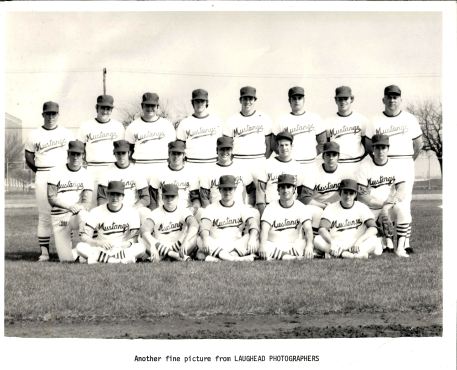
Top row:  Gerald Spivey, Terry Moore, John Park, John Glasgow, Ron Ridlehuber, Jon Astroth, Mike Mayes, Coach Bob Finley.

Middle row:  Rick Goodman, Jim Moffett, Art Widen, Randy Johnson, Bill Jones, Jeff Gabriel, John Matetich.

Bottom row:  Gene Hanson, Dennis Ford, Steve Proffitt, Sam Cangelosi, Roy Burroughs.

That is me in the exact center of this picture. At many times in my life, I’ve been reminded of the classic lyric line from rocker Bob Seger: “I wish I didn’t know now what I didn’t know then”. This is one of those times.

The Hook and The Call

Prologue: It was one of those muggy summer nights. Arena Park was dark and quiet except for one area, which was buzzing with activity: The Little League diamond. It was dusty from overuse. The rubber cleats of the players kicked up sluggish clouds that hung there, suspended in the heavy air. The ballpark lights had attracted legions of moths and June Bugs, just like they always did. The surrounding darkness, under canopies of large trees, was deep and ominous. The players in the field provided the constant chatter of encouragement to their pitcher. I was seven, too young to play, but I was there with my family to watch my older brother Larry play. At that moment, I was more interested in the large sand pile that was located down the right field line. What was it about running up and down those sand piles? I had sat down on the pile to empty my tennis shoes once more of the sand.  My sister Beth yelled to get my attention. “Larry’s batting!” I looked up in time to see him striding confidently to the plate. Man, he looked awesome in his grey pinstriped uniform. Someday, I thought.

The Hook:  “Congratulations, you’re on the Royals”

In the spring of 1962, it came to pass that all 8-year-old boys in Cape Girardeau, MO were compelled to do the following: arrive at Capaha Park’s north youth diamond, beyond the centerfield wall of the BIG FIELD, on a crisp April Saturday morning at 8 am with birth certificate, a bat and glove in tow, to register with the Minor-League Baseball Association (for ages 8-12) and in turn to try out for a team. “Did you bring a signed waiver from your parents?” It was our very first rite of spring. This was also our first opportunity to show certain adult baseball coaches that we had never heretofore met that we were worthy to be drafted to be on their teams. At last our skills, honed on sand lots and in back yards all around town, were finally put to use in organized baseball.

The coaches, these underappreciated men, many of whom did not even have kids in the program, dedicated substantial amounts of their free time away from their everyday lives and expended much energy teaching baseball, a game that they loved. Unsung heroes*, they were, no less.

I remember several things vividly about the day of the tryout: At the sign up table, we presented our birth certificates, and then we were all assigned a number. That number, written large on a sheet of typing paper was safety-pinned to the backs of our shirts, and remained there the rest of the day. The boys sized each other up, admiring new gloves, flashy new rubber cleats, and older brothers’ hand-me-down hats. My glove was a brand new Bob “Hurricane” Hazle Model. I remember standing around a lot and “fidgeting”.

After making the boys run a few sprints to “warm up” a large canvas bag of baseballs, mostly old and worn, was brought out and we paired off for some pitch and catch.  After about ten minutes of this, the men assigned us to one of three stations to test our level of skills at fielding, throwing, and hitting.

As our turns came, we were instructed to call out our number for the clipboard men to take their notes. Older players from the various teams hovered nearby with their team T-shirts and hats, checking out the rookies. The more confident ones jumped in to help the men with the tryout. There were coaches that stationed themselves at strategic spots around the field writing notes as we tried out. We were constantly reminded by the men to “show some hustle”. We were also in turn encouraged when we tried too hard and made mistakes. I remember some kid kicking at the dirt after booting a grounder. Hey that looked pretty cool, and so we tried it also. Of course it was all about looking cool.

When it came my turn to bat, I was a bundle of nerves. It was late in the day, and we were all getting tired and hungry. I think I swung at every pitch, and only connected once, a foul to the right side, while breaking the bat. It ended up near the big shade tree down the right field line. I fretted about the broken bat (it wasn’t mine) and got yelled at: “Next time, watch the trademark, son!”

I remember some of the Minor League team names: Marlins, Royals, Chiefs, Bisons, Pirates, Red Wings, Owls, Orioles, Eagles, others? I got the call from Manager John Schade a few days later. I was a Royal. New T-shirts and bright red hats with a white R stitched on it. My hat would soon have a hand-squeezed “crown” just like the rest of my teammates.

OK baseball, you’ve got me. I’m hooked.

The Call

After spending my first season on the Royals in Cape’s minor leagues (I was 8 in an 8-12 yr. old league), I was content to play for them again the next summer. Most of my classmates said they were doing the same. The alternative was to try to ‘move up’ to the more prestigious Little League, which was ostensibly for the more ‘serious’ players.  There were no guarantees that you would be selected at the tryout, anyway.

Memories of my first year in organized baseball were that I played the game in utter mediocrity, although I think our team was pretty good.  Nothing that I would call a personal accomplishment stands out in my memory. I do have one vivid visual image of that season, however. This happened more than once: I am on deck, watching my friend and teammate Mike Uhls getting hit by a pitch squarely in the back, and then this image of him, with his body contorted in pain; eyes closed, frozen in this grotesque pose, followed by a painful, red-faced trot to first base. Because I witnessed this from very close range, I think I spent most of my at-bats that year trying to avoid getting beaned. I wasn’t about to get beaned. I am also fairly certain that I was not productive, although my coaches, Corky Weiss, and John Schade were dedicated and supportive.

In fact, when the tryout was announced for the Little Leagues (9-12 yr. old), I, like many of my close friends, passed on the opportunity…..that is, until I got THE CALL.

I remember that I was watching TV, and the phone rang. I ignored it until I heard my sister Beth say: “Randy, it’s for you. It sounds like a grown man.” Huh?

“Um, hello?”

“Randy, this is Lloyd Slinkard, manager of the Little League Yankees. I am calling to see if you wanted to play on our team this year”.

“Uh, but I didn’t try out for Little League.”

“I know, but you can still play for us if you want.”

“Do I get a uniform?” (Minor League wore T-shirts and blue jeans)

“Well…..yes, you get to wear a uniform.”

“Where are the uniforms?”

“Well, right now they are in my basement, in my house.”

“OK, I’ll play. So, when do we get our uniforms?”

“I’ll distribute the uniforms sometime before our first game.” I am sure my obsession with the uniforms made Mr. Slinkard wonder about my reasons for agreeing to play on the Yankees.

All of a sudden, I was a Yankee. But what just happened? Wait a minute, this is the same team my older brother Larry had played on in years past, and his coach was indeed the same—Lloyd Slinkard. Hmmm. Ok, I get it now. Larry was a stud in Little League. He was a good 1/3 larger than some of the players and had hit a dozen home runs when he was eleven. He was scary to bat against. Larry was so good that Mr. Slinkard would take a chance on his little brother, sight unseen. Key question: What would Mr. Slinkard think when he sees I am an average sized nine-year old, and he comes to know that I have “happy feet” and don’t like to get hit by the pitch? I will worry about that later, because at least I will get to wear the uniform.

My first season in Little League, I played the minimum required amount each game, which was two innings in the field, and at least one at-bat. I remember striking out or walking a lot against twelve-year-old pitchers throwing heat. Since I am controlling the narrative here, let’s be kind and just say I was a ‘late bloomer’.  One Saturday afternoon, against the Red Sox I did have a very memorable at-bat against Tommy Taylor in which I hit a routine pop-up that Frank Kinder easily caught at second base for an out. I bragged about that for weeks.

994365_429380393832442_1790219654_n

This is a few years later, my 12-year-old self as a Yankee. My obsession with the uniforms continued. Mom would have my flannel uniform cleaned and my jersey pressed so that I could usually be fully dressed at noon for a five o’clock game.

*The unsung heroes:  Special thanks to these men, all of my baseball coaches and managers for instilling a life-long love for this game: Corky Weiss, John Schade, Lloyd Slinkard, Alfred “Casey” Ashby, Terry Ashby, Roger Suedekum, Jerry Dewrock, Doc Yallaly, Leon Brinkopf, Paul Kitchen, Dale Meier, Jess Bolen, Theo de Hoyos, and Bob Finley. Also, there are these senior baseball guys still getting it done: Sandy Cross, John Kaag, Fran Podraza, Carroll “Woody” Wood, and Dan Schindler.

The Rocks

Ray Bradbury was writing about his hometown of Waukegan, IL when he wrote his novel, Dandelion Wine, set in a fictional town called Greentown. It is a novel about remembrances, and loving your life enough to want to make lists so as not to forget important memories. It is also about coming to know that life is so fragile. Bradbury lovingly describes Waukegan (Greentown) as the paradise of his youth.

Similarly, in our neighborhood in the 1950’s and 1960’s on North Henderson Avenue in Cape Girardeau, MO, my friends and I had a landscape offered to us that would have made us the envy of kings. Henderson Avenue lays along the western edge of the campus of Southeast Missouri State (then) College. We could daily enjoy its spacious verdant hills. The college tennis courts were our fuzz-ball stadiums. The wide sidewalks were our bike trails. In fact, my friend Jimmy and I found a bike loop through the campus that started at his house and ended at his house that was downhill nearly all the way, defying physics. To the north we had the college dairy farm with its wild woods and endless meadows and crawdad filled creeks (watch your step on the cow patties); to the west, a few blocks of shaded streets led to Cape’s finest city park, Capaha Park; and just a few blocks to the south, Broadway with its thriving franchise-free variety of businesses. A location scout for a “coming of age” movie could not have found a better setting. Our activities naturally followed the seasons: baseball to football to basketball to sledding and back around again. The Crowes and the Johnsons both had whiffle ball fields and basketball courts, each with enough quirks to favor the home team. The Limbaugh’s backyard was large, flat and absent of trees and was made for tackle football. These gritty games were unsupervised tests of toughness; always an odd mix of dread and thrills for me.

Near the center of all of this activity was a curious pile of large, gray rocks, next to the gravel road leading to the college farm, just on the edge of college President Scully’s residence and grounds, and across the street from Dr. John T. Crowe’s house. It was a random jumble of undoubtedly forgotten and unused stone that was blasted out of Houck field’s quarry, the same as was provided for many of the older campus’s building exteriors. Why this pile was left in this spot is a mystery. To us, it would come to be known simply as “the rocks”.

The rocks would serve many practical purposes for the kids in the neighborhood. First, it was a central meeting place for other activities, as in “meet you at the rocks, bring your bat and glove”. It was a strategic common ground, a neutral site, always devoid of parents. It was also a “base” for holding prisoners in our all-day-team-hide and seek/war games we called ‘Hideaway’. Finally, because it sat much of the day in the shade, it would serve as a cool place to sit and talk in the summers when there were no timetables. I can still see our bicycles randomly splayed on the ground around them. “Thanks for the Kool-Aid, Mom.”

From this place, our summer days were often launched: Indian ball or ‘baseball 500’ at Capaha Park—(giving a wide berth to the crazy man’s house, of course); fuzz-ball at the college tennis courts; bike hikes to the public library and around town; excursions to Werner’s, Vandeven’s or Fischer’s for candy; the College Barber Shop for haircuts—(quick return trips there when our moms weren’t satisfied); side trips to Kinder’s house on Park Street with its deep green tunnel-canopy of trees; trips to the abandoned seismic study building known to us as Frankenstein’s Castle (did they black out the windows to scare the crap out of us?). The cool, damp wine cellar at the eastern edge of the Home of the Birds; Houck Stadium to watch the Indians’ football practice, or the sometimes-violent fraternity tackle games behind Kent Library; smoking grapevines near the college farm creek, and when we had the courage, hacking our way through the Tangley Woods. The labyrinth of secret paths, worn clear over the years through the dense dark ravines connecting Henderson Avenue to the West End Blvd and Price Drive neighborhoods.

I have tried to explain to others in recent months why I am becoming so nostalgic these days. It is futile, because I don’t really know myself. I do know this: the image I can conjure up of The Rocks is a catalyst for lots of other memories. I will leave it at this: this image has become more than a perfect metaphor; it is a genuine touchstone for me when I am trying to remember the stories of my youth.

The Rocks (large)

The Rocks can now exist only in my memory. My lifelong and fellow Henderson neighborhood friend, David Crowe, took a righteous picture of the rocks before they disappeared. It hangs in my home office. Thanks, Crowe, for this and loaning me your copy of Dandelion Wine all those years ago, underlines and margin notes and all.  Rest in peace, old friend.

Here we go……first blog entry

Baseball is not life, but it is and always has been a big part of my life. Because this is true, I have purposefully retained many memories of certain games, people, and incidents that are crystal clear. These memories span all of the levels of baseball I have played starting with the Minor Leagues in Cape Girardeau to the 60+ senior leagues in St. Louis, MO. Successes and my share of failures; all are part of the fabric, and if you pull a loose thread, a story might unravel and reveal itself. Over the years I have told many of these stories so often that my wife, Rita, encouraged me some time ago to write them down.

This is also true: we tend to tweak and edit ever so subtly the scripts of our triumphs here and there to suit ourselves and fit the narratives we would like others to think about us. This does not make us bad people, rather only human. As to failures, they will seem magnified or diminished based on how we feel about ourselves at any point in time. Those thoughts are always there, however.

Many of the stories in this blog will center around my college baseball days. Success in baseball at SMU would turn out to be fleeting for me and my teammates. On the other hand, it should also be mentioned that baseball is, and always has been, a game of redemption. That may be ultimately the reason I love it so much. The next game will always and forever be that opportunity for redemption. To that point, I have been lucky to be able to play this game into my sixties, thanks to men’s senior baseball and other men my age with the same passion for the game. I am in my eighth retirement, currently, although my agent is listening to offers.

In the big scheme of things, my baseball career has mattered little, as it was not a large stage. A relative few are chosen for the large stage, although it should be noted that baseball is mostly played on a myriad of small stages. The drama and the humor and the occasional poignancy are nonetheless real. The following stories really did happen, tempered only by my memory.