The Letter

Prologue:

Fuzzball…..the name rolls off the tongue quite nicely. Like many games, my first exposure to fuzzball was by watching. I can remember shyly standing behind the screen at the college tennis courts next to Cheney Hall watching the older guys (demigods to us) like my brother Larry, Terry Ashby, Steve Mosley, Al Kesterson, John Brandt, R C Grossheider, and others. We were highly impressionable, and were especially in awe of the satisfying sizzling sound that a tennis ball made, with its cover worn down to a stubble, when thrown at high velocity with the equally satisfying ‘pop’ into the deep pocket of a well-worn glove. Zzzzzip-pop. Zzzzzip-pop. Zzzzip-pop. Intoxicating. Yeah, I want some of that, I thought. Eventually, our day would come for this wonderful game.

The Game

Fuzzball is a variation of baseball, and very similar to cork-ball. Cork-ball, played with a miniature leather baseball-like sphere and a long skinny bat, has strong roots in St. Louis, and still to this day has competitive leagues playing the game in South St. Louis. We tried playing cork-ball in our youth but my memory of the game was that there were a lot of swings and misses, and when you did connect, the cork-ball went a long way and was immediately lost in the weeds. Then another trip to Howard’s Sporting Goods was required for a replacement. We decided that fuzzball was more efficient and more fun. I don’t think the game is still played by the youth of today. We sure played a lot of it in our neighborhood growing up in Cape Girardeau, Missouri in the 1960’s.

The rules that are particular to fuzzball are similar to cork-ball, which tend to make the game move along very quickly: 1) The ideal game is two on two: This allows for the minimum of a pitcher and catcher for each team defensively. It also means you get a lot of at-bats on offense. Having just two batters per team works because you employ “imaginary runners”. 2) The catcher is the umpire and there are three balls for a walk, and two strikes for an out. 3) A foul of any kind is an out. 4) Every ball that is hit in fair territory is a single, except for a ball hit over the fence of the tennis court which is naturally a home-run.  5) One swinging strike is an out if the catcher snags the pitch cleanly. 6) Any ball fielded cleanly by the pitcher was an out, and further, a batted ball on one hop to the pitcher is a double play if there are base runners. Also, a foul tip the catcher hangs onto is a double play with runners on base. Other than a few other nuances, those are the rules.  All you need is a well worn tennis ball and a long, thin cork-ball bat or thick broomstick, and you were in business. Some actually would burn the fuzz off of the tennis balls with a blowtorch, the smoother the better.  This game could be played anywhere, but the best place to play was on a tennis court, pitching into one of the corners.  One of our T-shirts would be home plate.

Hitting was sufficiently challenging; pitchers threw hard and also threw torqued-up hard breaking pitches.  Hacking at these pitches with a narrow broomstick or skinny cork-ball bat made squaring a ball up difficult for the most part. But oh, when you connected… …..wow…. prodigious, towering, majestic home runs into the next courts and beyond. It was perfect for young ballplayers living out fantasies of their heroes. Because we didn’t have to run the bases, it was expected and acceptable to stand and admire your homeruns.

My neighborhood fuzz-ball contemporaries when I played were Jimmy “Mack” Limbaugh, David “Crowe” Crowe, Robert “Moe” Meyer, Frank Kinder, Steve “Chops” Limbaugh, David “Doc” Limbaugh, Malcolm Montgomery, David “Bird-wan” Bertrand, Mike “Joe” Uhls, and Skip “Skeepie” Reams, and others. Occasionally, another classmate from the northwest side, Bobby Ervin, and I would take on challengers at Capaha Park. Bobby was one helluva ballplayer and one summer he and I went undefeated. (At least that is what Bobby and I have insisted for all these years).

A few other random memories:

• A very practical skill that was helpful was being able to ride a bike with a long skinny bat clamped with your thumbs to the handlebar.
• One summer, Steve “Chops” Limbaugh went on an insane home run spree. This seemed to come out of nowhere. Everyone was amazed.  Chops would eventually cross over to the dark side, dropping baseball in favor of actual tennis. He was very good, too.
• Crowe’s pitching repertoire included a very slow, mediocre and hittable curve ball that he called his “double scoobie doo with a twist”. The hype exceeded the quality on this one. All I have to do is think of this and it makes me smile.

The Letter

“Sorry boys, take your game somewhere else”

Fuzzball and traditional tennis do not mix very well. A fuzzball game tends to encroach on other adjacent courts fairly often. It could lead to uneasy encounters. One sunny summer morning a tennis playing adult couple arrived while we were playing fuzzball at the college courts and had the audacity to ask us to leave, so they could play their tennis game on our court. Whaaaat? Grumpy, but compliant of the request, we went home.  In the vernacular of the day, we were “run off”.

I did not witness the conversation that evening at the Crowe home, but there must have been something about the story that David Crowe brought home about our encounter that day did not sit well with Dr. John T. Crowe. It spurred him to make a purposeful phone call to the President of Southeast Missouri State College, Dr. Mark Scully. I have to believe that one or more of these concepts, such as “tax paying citizens”, “good community relations”, and “proper stewardship of university resources” may have come up in Dr. Crowe’s conversation with Dr. Scully. Knowing Dr. Crowe, some salty language was likely interspersed.  The result was a bona fide letter from Dr. Scully on his official letterhead to “Whom It May Concern”, explaining the above concepts and culminating in a statement that these young boys had every right to play fuzzball on the Southeast Missouri State tennis courts.

Crowe would carry this letter in his pocket when we played fuzzball at the college courts, with the hope for an opportunity to throw it down on some tennis playing jerk. We all wanted to be there when that card was played. Alas, I don’t think he ever got to use it. Crowe, Mr. Double Scoobie Doo himself, claimed to still have the letter the last time we spoke of this, some years ago. Rest in Peace, old friend.

Hobbs

Image1 (10)

Way back in 2006, right before Christmas, I suggested to Rita that we might consider adopting a dog. We needed a little change in karma, and thought this might be just what we needed at the time. It was. After looking around at the local humane societies, we heard about an adoption day at a local pet store in South County. There he was in his own crate, yapping for attention from anyone within earshot. He was a small brown short legged mix, his short hair surprisingly soft when I picked him up. He went silent and docile in my arms, a trait he carried all of his life. Maybe he was just like a lot of us, and enjoyed being held. I asked about his background, and was told he was picked up on the run “down around Lonedell” (MO). His first given name was Bandit, was about six months old at the time, and had been returned from his first adoptive home because he didn’t get along with a cat that had seniority. On his first trip to the vet, we asked if they had an opinion as to his breed. His size and profile suggested Jack Russell Terrier, and his mottled tongue suggested a Chow or Shar Pei lineage. The vet’s assistant, walking by, took one look, and said he had a little “el diablo” in him. Indeed.

The kids were excited and surprised, and after a couple of days we decided to rename him Roy Hobbs. Other names considered: Yadi (Molina) and Crash (Davis from Bull Durham). Yes, we are a baseball family. Hobbs, as he came to be known, was an instant hit with the kids: A tour-de-force, with equal parts of relentless high energy, perpetual motion, stubbornness, nosiness, relentless jumping as a means of expression, barking, and a high distrust of any non-Johnson that came to our door. He could reduce a doggie toy stuffed animal to a limp carcass in about twenty minutes with its contents looking like a fresh snowfall. Most of the time, his bark was worse than his bite; but on a few occasions, as a few of the kids’ friends could attest, the opposite was true. Hobbs was obsessed with food, a result no doubt of his wandering days on the run.

He was a runner, and yes, more than a few times, got away from us off the leash. It was a worry because he was fearless, not very intuitive, and had no idea about the streets. He would disappear into the woods behind our house and beyond. It became a little easier to lure him back when he learned the meaning of the word “treat!”. Also, a big thank you to the nice young lady that was somehow able to lure him into her Jeep one afternoon before driving around our neighborhood. The Jeep pulled up next to me standing on the sidewalk leash in hand, and this little brown puppy face popped up with a smug self-assured look. “Hi, Dad, are you looking for me?”

Hobbs’ hyperactive life finally caught up to him this past year. His joints had eventually failed him; knee surgery didn’t quite do the trick and he had been pretty much bed ridden in recent months, barely able to stand on his own. Laine, if love alone could have healed him, he would have been fine. You have been his amazing loyal companion, and he loved and trusted you like no one else.

I couldn’t read his thoughts, but I just imagine that he had to be ready to move on. I hope there is a place in heaven for dogs so he can run again. Hobbs, you were not a perfect dog, but only perfect in your quirks and insecurities. Thanks, Hobbs, for your companionship, loyalty, and being the best dog that you knew how to be. Your mission is complete on this earth. Well done, old friend. Good boy, Hobbs! Good Boy!

The Tourney

My Junior season, SMU Baseball, 1975

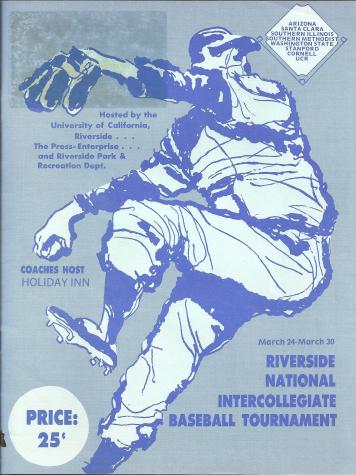
We started hearing rumors of a California trip as early as my freshman year, 1973. I am not sure I actually believed it until our schedule came out in early 1975. Not surprisingly, our pre-season roster ballooned to 30 players that spring. Finley had to fight guys off with a stick during tryouts. Then, of course, the fight was on for the travel team roster. Yes, ladies and gentlemen, in the spring of 1975, the Mustangs indeed took a trip to California to play in the prestigious Riverside Baseball Tournament. How did the Mustangs get invited to this tournament with such national powers as Stanford, Santa Clara, Arizona, Southern Illinois and Washington State? Well……um, nothing comes to mind. I have no clues whatsoever. Coach Finley must have pulled in a few extremely large favors or something.
043

The complete field of teams included UC Riverside (the host team), Cornell, and the aforementioned Arizona, Stanford, Santa Clara, Southern Illinois, and the Mustangs. We were no doubt an unknown quantity to the rest of the teams. I’m sure we garnered some respect for the simple reason we played in the Southwest Conference. I mean, in their minds, how bad could we be, right?

SMU’s California Tournament Roster:

PITCHERS: Jim “Hollywood” Warren, Ed “Easy Ed” Cantwell, Randy “Rookie” Johnson, Mike Hall, Jeff “Workhorse” Sage, John P. “J P” Schlensker, Tino Zaragoza

CATCHER: Bruce Gietzen (injured)

INFIELDERS: Jack “Pandy” Speake, Don “Smoke” Jarma, Mike “Jake” Jaccar, Gene “Snake” Hanson, Ron “Hubie” Ridlehuber

OUTFIELDERS: Jeff Johnson, Mark “Hambone” Hammond, Dudley “Dud” Parker, John “Billy Goat” Sagehorn, Rusty “Burk” Bourquein, Ted “Teddy Ballgame” Thompson

DH: John “Whale” Park

Coaches: Bob “H S” Finley, Jim Moffett

Prior to leaving Dallas, we all got the big lecture from Coach Finley about behaving ourselves, and representing our university with class and reasonably civil behavior. For the most part, I think we complied, although some of us wore leisure suits, pukka shell necklaces, and shiny flowery shirts on the plane. Does that count? In fact, Coach Finley warned us of a mythical “pre-paid” early plane ticket back to Dallas for anyone that did something really stupid during the tournament. It went un-used, fortunately.

For our better players, it would be a showcase. Scouts would be there. Mike Jaccar, John Sagehorn, Don Jarma and Ron Ridlehuber would garner some attention. Ironically, it would be someone a bit more unexpected that would have a monster tournament, and create the buzz for SMU that week. We would be without our starting catcher, Bruce Gietzen, who was injured. The position of catcher would be filled by a committee consisting of: utility man Jeff Johnson, first baseman Ron Ridlehuber and third baseman Don Jarma.

The accommodations for the players were in the form of volunteer families hosting groups of 2-4 players each. The only exceptions were the players whose parents accompanied the team to California. Upon arrival, Finley announced roommates. In his cosmic wisdom, I was paired with Tino Zaragoza. We were an unlikely duo to say the least. I was the conservative Midwesterner with the wide-eyed expression on my face most of the time. On the baseball field I was competitive, but I had always been taught not to let the hitters see any emotion, regardless of the circumstances. Tino, by contrast, was gregarious and demonstrative.  I can’t help but believe that I was paired with Tino as a safe companion, at least in part to assure that Finley didn’t have to use that extra ticket back to Dallas on him.

At the pre-tournament reception for players, Tino and I grabbed our bags and headed for the table with the family assignments. There was an envelope with our names on it, and inside was a slip of paper that said: “Mrs. B. Williams” and a phone number. We looked around for what we thought might be an older woman, possibly a widow? Instead, there was a 40ish looking woman, who introduced herself as an athletic staff member there at UC Riverside. “Mrs. B. Williams” turned out to be a divorced lady with a younger and very attractive roommate named Connie. They lived in a three bedroom apartment in what is best described as a well-kept large singles apartment complex near the campus. Hmm. Well, OK, let’s do this. After all, this is California and in the midst of the 1970’s. I cannot confess to any wild fantasies coming true for me that week, other than a few stimulating bikini-clad groups sipping mai-tai’s in the complex’s hot tub. I do remember, however, that Tino chose to sleep ‘on the couch’ in the apartment’s living room, so I had the guest room to myself. I also remember Tino and Connie spending a lot of time together. Tino’s smug expression told the rest of the story.

This was the ninth year for the Riverside National Intercollegiate Baseball Tournament. It had been generally cited as the best early season tournament in the country. Major leaguers Steve Dunning (Stanford), Dave Kingman (USC), Doug Howard (Brigham Young), Bump Wills (ASU) and Alan Bannister (ASU) had played there. Archie Manning of Ole Miss held the record for triples for the tournament. Other notable teams that had played in prior tournaments were Tennessee, USC, UCLA, Arizona State, Mississippi State, and Oklahoma.

At practice on Monday morning:

The Mustangs were comparing notes about the families to which each player had been assigned. The players’ stories were all over the map. The stories ranged from Tino’s and my swinging singles apartment arrangement to a doctor’s mansion on the side of a mountain overlooking Riverside, where the guys were able to take over what sounded like an upscale man-cave: a walkout basement with wet bar stocked with Olympia Beer, pool table, and their own entrance that opened to a pool area. The cute teen-aged daughter with friends using the pool was also a nice touch. Not particularly fair and equitable, but I guess neither is life for that matter.

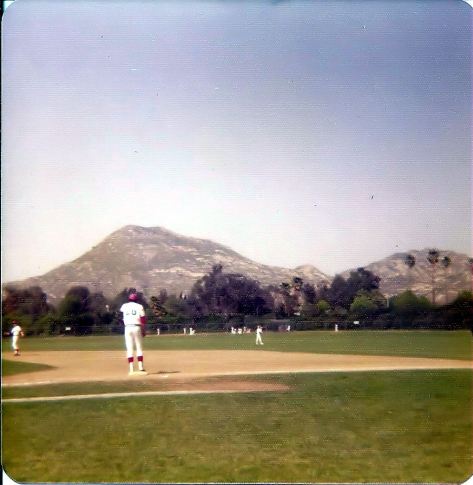
Practice was just this side of heaven for us: Beautiful California sunshine, mountains in the background, and everyone in good spirits. There was the insistent ‘pinging’ of metal bats and good natured grab-ass shenanigans. There was palpable excitement in the air. Plans were being made to visit nearby Newport Beach, and Disneyland. Teammates rehearsing anticipated conversations in their heads with Major League Scouts. We were expecting tough baseball competition and the opportunity to measure our pitch repertoires against really good hitters and vice versa. We were looking forward to playing nationally ranked teams that weren’t obnoxious and wearing burnt orange. Even the surliest of players were smiling and sprinting after balls hit into the outfield. Coach Finley was more than a little giddy: a local sports reporter was there to interview him for a feature article. All the old stories spilled out like a fresh spring fountain: The Rose Bowl, the $85,000 Pass, TCU rival Sammy Baugh, the Phillies, and the old AFL. A new audience to a story teller of Coach Finley’s ilk had to be intoxicating. It was all good. It put a spring in everyone’s step.

There was the usual light banter: If someone swung and missed, you might hear, “It’s a long way to Omaha!” If someone hit a medium deep fly ball, “Go home, lift weights, come back next year!” If someone dropped a ball, “That’s OK, if you were any good you’d be at Texas!”
013 (3)001 (4)

I sauntered up to Jeff Sage in the outfield and told him I wanted to hear (again) his memorized –18 minutes long– rendition of “Alice’s Restaurant Massacree” by Arlo Guthrie. (Yes, it is 18 minutes long, and yes, he memorized it. All of it. Every word.  It was a party trick on steroids). Delighted, Sage launches into it: “Now it all started two Thanksgivings ago, blah, blah, blah…” Nearby players cursed at me, and moved away quickly. I also walked away smirking, leaving Sage in mid-sentence. Sage sure knew how to clear a room!

UC Riverside:

The Mustangs showed up bright and early for their first game at Evans Park in Riverside to play the host squad, University of California-Riverside (UCR). I don’t remember much about the game, but the peripheral things-the bright sunshine, the luminescent green grass, the warm temperature, and the loud but respectful crowd—all of these remain in my memory. We lost 9-6, and I remember a competitive game. (UC-Riverside is the alma mater of former Cardinal and current Red Sox pitcher Joe Kelly!)

Cornell:

Our second game was against Cornell, an Ivy League school, and in theory, probably SMU’s best chance at a victory. The game proved that theory to be true. Tino started, and had one of his typical games. He never really dominated when he pitched, but he always seemed to pitch as well as he needed to give the Mustangs a chance. Cornell jumped on top 2-0 and added a run in the top of the third. SMU scored four in the bottom of the third, and it remained 4-3 going into the top of the ninth. Tino, tiring in the ninth, gave up three runs without recording an out, and left the game with SMU trailing 6-4. Finley decided he was done; he had scattered 12 hits, but only walked two and was a bulldog as usual. Finley brought in JP Schlensker to relieve Tino. JP stopped the bleeding by retiring the side. Then lightning struck as SMU then rallied in the bottom of the ninth to tie the game at 6-6 on a clutch, pinch-hit double by John “Whale” Park. Prior to this at-bat, Whale had been in a terrible slump, having struck out in 11 of his previous 13 at-bats. Meanwhile, JP was tough; after shutting off the Crimson Knights’ rally in the ninth inning, he blanked Cornell for the next three innings on two hits and no walks. This allowed the Mustangs to rally in the bottom of the twelfth for a walk-off win, 7-6. Jake Jaccar scored the winning run when Cornell’s shortstop pulled their catcher off home plate on a force play at home. The Mustangs made good use of its nine hits, and the hitting stars of the game were Huber and Burk, with two hits each. The 6’8” Burk also contributed in a large way with four RBI’s on a grand slam. His Herman Munster-like blast cleared a 25 foot high fence at 380 feet and ended up at a gas station across the street.

SMU Cornell box

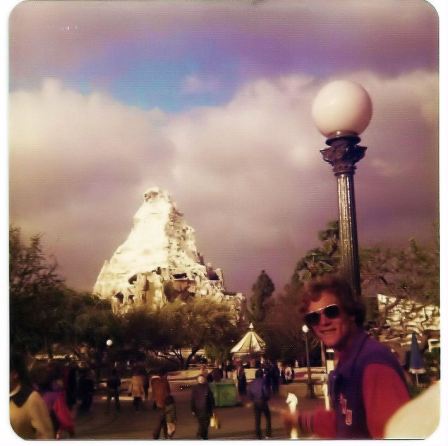
After our game, eight of us hit the road for Disneyland. JP, Warren, Sage, Pandy, Jeff Johnson, Dudley and I loaded up and headed to Anaheim. Warren was on a mission to meet Minnie. This was a reprise from my first trip in 1966 with my family. California has always been alluring to me. As a kid from the Midwest, I saw only the packaged, promoted side of California:  the surfing culture, the music.  Disneyland, always fresh-painted and updated, added to the allure. We must have regressed at least 10 years each on our trip to D-Land.
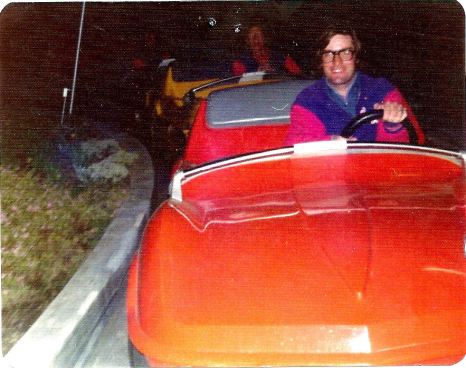
scan0052Mustangs take Disneyland 1975Jim Warren is looking for Minnie

The next day, JP, pitching hero of the Cornell game, sidles up to me in the outfield before the game.

He said, “Man, my elbow is killing me!” He had a sheepish look on his face.

“So what?”

“We were up all night throwing darts.”

JP was one of the lucky ones staying in the mansion on the side of the mountain near Riverside. Apparently those nice accommodations included a professional grade dartboard. The mechanics of throwing darts are apparently very different from throwing a baseball, so much that it gave them all sore elbows.

Stanford:

Stanford, the class of the tournament, thrashed us on Wednesday. They got to our starter, Jeff Sage, early for 6 runs in the first three innings. Jim Warren relieved in the fourth inning and finished the game. Jim had a pretty good outing, yielding only 4 earned runs in 5 innings. Final score was 11-0. Mike Williamson, Stanford’s returning All-Pac8 senior stifled us on two hits, and had 13 strikeouts. Ugh.
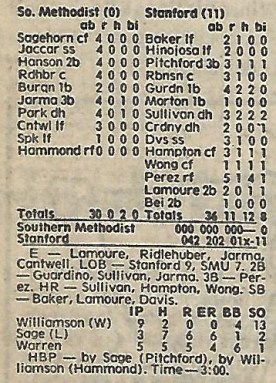
SMU Stanford box

Santa Clara:

I got to pitch against USC on Thursday night. No, not that USC. The University of Santa Clara Broncos. This team, from northern California played in the West Coast Athletic Conference. They had finished 38-17 the previous season, and with four returning seniors on their pitching staff, the Broncos were one of the tournament favorites. Their record coming in to the tournament was 17-5, and they were coming off an impressive 11-2 win over SIU Carbondale. The game did not start well. While we scored one in the top of the first, the Broncos came back with four in the bottom. Not good. We did battle in this one, however. I put a string of four zeroes for the next four innings, and going in to the bottom of the sixth, we were tied 4-4. Alas, the sixth inning was not kind to me and my Mustang teammates. The Broncos pushed across three more runs, and I got the hook with two outs. Mike Hall pitched next but didn’t fare any better. He finished the game, with the Mustangs losing by a final score of 12-5. The box score showed that we hit pretty well (11 hits), but made 4 errors and left 11 on base. Very disappointing.

SMU Santa Clara box

SIU Carbondale:

SIU, the Salukis from Carbondale Illinois, were coming off a record year in 1974. Led by Coach Richard “Itchy” Jones, they had finished third in the College World Series with a 50-12 won-loss record. Featuring outfielder George Vukovich, they brought the big lumber to the tournament. Vukovich would go on to a nice six year career with the Phillies and the Indians. JP got the start, and it became evident early on that this would be no pitcher’s duel. The Mustangs broke on top with three runs in the top of the first, and SIU came right back with two in the bottom. The Salukis tied it at three all with a run in the second. The Mustangs pushed another run across in the fourth and added two more in the top of the fifth for a 6-3 lead. The free swinging Salukis put up crooked numbers in each of the remaining innings to win by a final score of 15-7. JP and Hollywood Warren shared the pitching duties in this one. Pretty ugly, although Rusty Bourquein continued his barrage with three hits and four RBI’s including another home run. Don Jarma filled in as catcher and had a two hit, two RBI game.  Mike Jaccar and Pandy Speake also had two hits.

SMU SIU box

Arizona:

Tino got his second start of the tournament against the loaded Arizona Wildcats. The Wildcats had set several tournament records earlier in the week by smoking Santa Clara 27-1. Tino was up to the task early in the contest, and we had a game for a while there. The game was tied at 2-2 at the end of 4 innings. At that point, Arizona’s hitters began measuring Tino’s pitches pretty well. Tino finished seven innings and left the game trailing 9-2. Ed Cantwell mopped up the final two innings, and the final score was 14-2. The one bright spot was a home run with a runner on by Smoke Jarma. That one left us at 1-5 in the tournament and seemed to take all the wind out of our sails. Jarma did a great job behind the plate, and apparently chatted up the Wildcat hitters to the point of great frustration. Apparently he kept calling out loud for our pitchers to throw the “bugs bunny” pitch, i.e. the change-up.  Arizona hitter Ron Hassey finally complained to the ump:  “Can’t you make this guy shut up?!”  Hassey went on to a 15 year major league career with the Cleveland Indians and others.
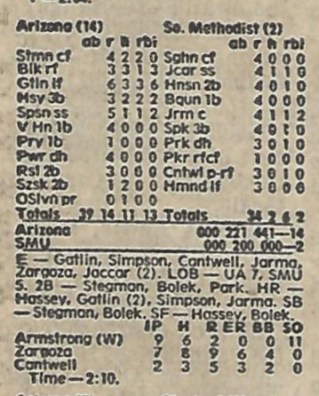
SMU Arizona box

Washington State:

My great uncle, Irving Lindquist, lived in nearby Yucaipa, California. At my Dad’s suggestion, I had called Uncle Irving to tell him I was coming to California. Uncle Irving was one of my favorite uncles. He was a quiet gentle spirit, and a kind man, who always took a genuine interest in all of his nieces and nephews. Even though he lived most of his adult life in California, he had always remained close to my family, especially Dad. I was grateful that he wanted to see me play. He white-knuckled it through the considerable Southern California freeway traffic to see me pitch against Washington State.
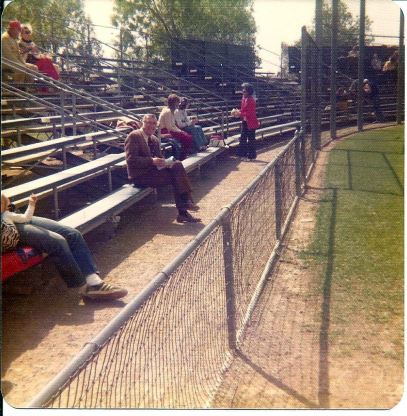
012 (3)

Above:  My Uncle Irving, looking a little overdressed for the game.

The Cougars had made a nice showing in this tournament. With a tourney record of 4-2, WSU only needed to beat us to get into the championship game. The game was early in the day; in fact, we were scheduled to fly back to Dallas later in the afternoon. Our record was 1-5 up to that point, and although we were competitive in all but a couple of our games, we had very little to show for our efforts.

I started that game and remember having pretty good stuff. I had gone through their lineup the first time yielding only a single hit. In the fourth inning, I got the first two outs, and then this happened: One of those scary moments that make other pitchers turn away and wince. Coaches’ hearts skip two beats. Moms and Dads catch their collective breath and say a quick prayer. That moment that stops a hitter right in his tracks. Catchers and umpires instinctively rip their masks off and take a cautious step forward. Fans in the crowd exhale an audible gasp, then silence….

I was in my follow-through, and my head was slightly cocked to the right. I had just thrown a knee high fastball but instead of disappearing safely into the mitt, the ball suddenly grew exponentially in size. This cartoon-like sphere was tracking straight for my left eye socket at about 100 mph. How fast do neurons transmit information from our optic nerve to our brains? I don’t know, but this time it was just barely fast enough. As a reflex, my left hand jerked up toward my face. Impact. The ball caught the side of my pitching hand flush with an odd “splat” sound. My next thoughts, all in the space of the next two seconds, went something like this: First thought: I just broke my hand and I am out for the rest of the season. Second thought: why is there a baseball wedged under my right arm? Third thought: Am I supposed to do something with it? Yes. I remember. Throw it to first base. Fourth thought: OK, with what? This broken left hand, I guess. Really? Well, OK, this might hurt just a bit.

I remember it was a pitiful throw. Ouch. I was right…that hurt.

I didn’t realize that the umpire had ruled the batter out with my armpit catch. I looked at my hand, and there was a crescent shaped indentation the size of a baseball in my hand. The baseball had left a perfect track of stiches in my skin. My left pinkie finger was sticking out at a weird 90 degree angle. The baseball had broken the two outer-most bones in the meat of my left hand. I was toast for the rest of this season. Did I hear, or maybe I just dreamed Huber or Snake saying, “You gotta charge those, Rookie!”

Apparently—I was partially in shock and don’t remember much about this—I went into some kind of a personality change, bossing people around like a shop foreman. According to witnesses, I was barking orders to everyone–including Coach Finley– to warm up pitchers to replace me, telling everyone to get out of my way, and demanding a ride to the training room, etc. Actually, it was my Uncle Irving that took me to the training room, and stayed with me all through the ordeal. The physician eventually arrived, then pushed and massaged my hand back to its original shape, and casted me. Yeah. That hurt too, boy.

I wish I had been there to watch the rest of the WSU game. We “geared up and got after ‘em” to borrow one of Coach Finley’s lines. We knocked WSU out of the finals by beating them, 5-3. By my teammates’ accounts it was our best game of the tournament. We had timely hits, Mike Hall relieved me and was a bulldog on the mound, and our defense was stout. And finally, when the game was on the line at the end, third baseman Jack Speake made a game saving play to finish it.

Burk had the monster week. He had always been a solid hitter, but he got on a streak and mashed–ridiculously so. He finished the tournament at .379 with four home runs (tied the tourney record) and 12 RBI’s. Huber (3 HR’s) and Smoke (2 HR’s) came up large stepping into the breach at catcher. Jake was his usual pesky tough out at the plate. Whale looked like he got his timing back, too. Pandy finally got some quality innings to show what he could do at third base while Smoke was catching. Our pitching was sharp at times, but we needed more depth.

UCR replaced Washington State in the championship and promptly won its own tournament, partly because of a fine showing by freshman pitcher Eric Show. Show went on to win 101 games in the major leagues, mostly for San Diego. He is also remembered as the guy who gave up Pete Rose’s 4,192nd hit to break Ty Cobb’s record on September 11, 1985. Tragically, Eric Show died of a drug overdose in 1994 shortly after checking himself into an alcohol and drug rehabilitation center.

The rest of the trip is a bit of a blur for me, but I remember this: The team was buoyant, the result of our victory over WSU. It was great to see. These are some great guys, and always played the game we love with a lot of heart.
065

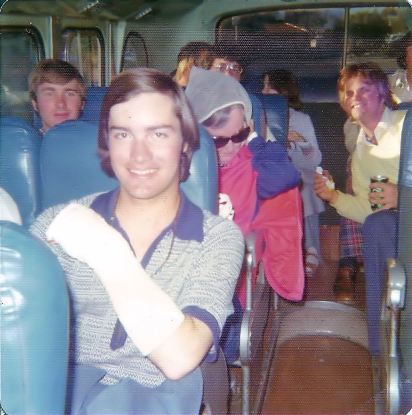
The above picture was taken on the bus to the airport.  The cast is real, the smile is fake. I remember the real world settling in on the flight back. My season was done, and my casted left hand would create some very practical problems the rest of the semester: primarily taking notes in class, but also writing answers to finals in the blue books, and keeping the cast out of the shower and the rain. This might also set me back a little bit with my summer league team, the Capahas, and my job house painting for Mr. Hinck. These events of the California trip would remain vivid in my memory to this day.
003

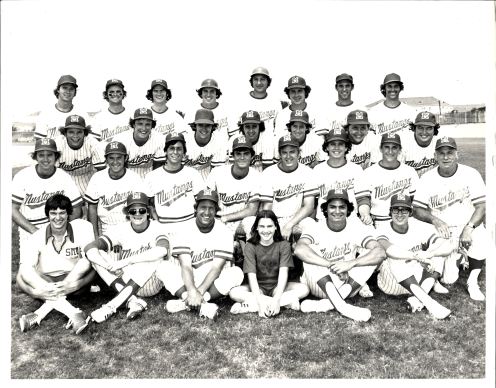
Pictured above, front row:  Steve Smith, Jim Warren, Clint Brown,  Allison Parr, Tino Zaragoza, Jeff Johnson.  Second row: Jim Moffit, Jack Speake,  Rob Stephen, Jeff Sage, Ed Cantwell,  J.P. Schlensker, Chris Ritchie,  Coach Finley.   Third row:  Mike Jaccar, Gene Hanson, Dudley Parker, Rob Goss, Grant Smith, Bruce Gietzen, John Park.  Top row:  Kevin Charlton, Mark Hammond, John Sagehorn, Ron Ridlehuber, Rusty Bourquein, Ted Thompson, Don Jarma, Mike Hall.

This picture is the 1975 version of the Mustangs taken at our last series in Fort Worth at TCU. Because I was injured and out for the season, my uniform was given to Freshmen Kevin Charlton. Finley was pissed that I showed up in cutoffs and a Mickey Mouse tee shirt and did not let me in the picture. I actually understand this, but still…..sigh…..

Coach Finley

Coach Finley

Robert Edward “Horseshit” Finley came to SMU in the early 1930’s as a young athlete. He earned his nickname by calling everything he did not like or agree with “horseshit”. He was one of a kind, plain and simple. As I heard one person put it: “They broke the mold, then immediately killed the mold-maker”. He had a perpetual look in his eye that made you think he was always ‘up to something’. He usually was.  I will attempt to describe him the best I can.

Coach Finley played baseball and football for the Mustangs.  He was a star fullback for SMU during the glory years of the 1930’s. He was on SMU’s 1935 national champion football team, and the 1936 Rose Bowl team. On November 30, 1935 #1 ranked SMU played a key game against #2 ranked TCU whose team featured the famous Slingin’ Sammy Baugh. Finley, the SMU punter, was back to punt in a key play late in the game trailing the Horned Frogs 14-13. He faked the punt and threw a 37 yard touchdown pass to Bobby Wilson to win the game 20-14. It has been called the $85,000 Pass, because it allowed SMU to go to the Rose Bowl that season and earn some large fees for their appearance. Finley went on to be drafted by the Pittsburgh Steelers, but instead chose to play baseball as a catcher.  He was signed by the Red Sox in 1937 and played in their minor league organization for six seasons.  He was traded in 1943 to the Phillies and played in a couple of seasons in the major leagues with them. He later became an American Football League referee for all nine years of their existence.

Finley coached the SMU baseball team from 1965 to 1976. During this time, he had a full-time sales job for a company based in Dallas, and I remember hearing one time that he coached the Mustangs for a small $800/yr. stipend. He just liked being around the game. As a coach, he was strictly ‘old school’. By that I mean he set the line-up and managed the games, but not much else. He expected you to show up on time and to play hard. Our practices were undisciplined and laid back. You were expected to run and throw on your own to get in shape. Most practices, the pitchers shagged balls in the outfield, while the rest of the team took a couple of rounds of batting practice. One round of infield practice at the end, and we were done.

Coach Finley raised enough money in the Dallas community for us play in the prestigious Riverside, CA tournament in 1975. Intensely loyal, he routinely battled umpires on behalf of his players. There are numerous stories, some of which I am saving for another time, so I will choose to use some of his better known quotes to show his personality:

“Alright now, let’s gear up and get after ’em!”

To our hometown umpire:  “Come on, Ernie, that’s horseshit!”

“All I ask you to do is what I ask you to do!”

“Where do you eat? You eat where you eat, Dammit!”

“Ho-ly cats, Tino!”

(After a batted ball low-bridged him down the left field line in batting practice at Dallas Baptist) “Hot dammit, hit the ball straight!”

“Dammit Johnson, throw hard!”

Heckling the piano player in a bar at the Shamrock Hilton in Houston:  “Do you know Bonaparte’s Retreat?” and “Play something you know next time!”

“Stay out of that butcher shop!”

“Johnson, your eyes look like two pee-holes in the snow!”

Coach Finley passed away in 1986. This world has been less fun ever since.

Attached is a news spot, a glimpse of SMU Coach Finley in 1974, giving life to the legend if you never had the privilege of meeting the man.  In this clip, I’m again the lefty catching in for John “Whale” Park, who was hitting popups into the wind to the infielders.

A Lesson in Politics

“Principal Miller, Franklin Faculty, and fellow students at Franklin School……”

As a sixth grader at Franklin School in Cape Girardeau, Missouri in the fall of 1965, if one was bestowed the honor of being his or her classroom Student Council Representative, this person automatically became a candidate for President of the Student Council, to be voted on by all students in all grades at the school. I was not aware of this, when I was put on the ballot for class representative in Mr. Gehring’s class.  When I did learn of this fact, I instantly became a reluctant candidate, knowing full well that a speech in front of the entire school was now imminent. Yikes!  My opponent in the race was my friend Skip Reams.

In my life up to this point I was not much of a leader. My childhood had up to that point demonstrated that I was always a good and faithful follower, however.  I preferred being on the periphery; out of the spotlight. There were plenty of good friends that fell into that leadership role much better than I did. To say I was uncomfortable with this Student Council President business was an understatement. I just didn’t want any part of it.
I am also a procrastinator. With our assembly on Monday, I had not written my speech, planning to do so on the Sunday evening before, as was typical. In fact, I spent Sunday afternoon hanging around with my friend Jim Limbaugh playing football in the neighborhood. As the afternoon shadows began to lengthen, we found ourselves hanging out in the Cotner’s back yard on Hillcrest Drive, and sneaking shy looks at the Cotner girls and their friends bouncing on their trampoline. Jimmy and I were passing the football back and forth in an attempt to impress the girls, look casually cool, and most of all, to try to mask our obvious ogling. At some point, I went out for a pass and face-planted in full stride into a large tree trunk! I think I actually saw stars, and heard a few audible gasps from those nearby. The impact left a raw patch of skin on my right cheek about the size of a deck of playing cards. It stung, but of course I acted like it was nothing.

When I got home, the “Oh My” expression on Mom’s face let me know it was not “nothing”. By then, my cheek had gone from an oozing, pulpy mass to being scabbed over, and was too big of course to hide with a bandage. As I looked at myself in the mirror, I was thinking about school, speeches, standing in front of hundreds of grossed out kids with this hideous disfigurement. I simply told Mom: “I’m staying home tomorrow”. I just blurted it out, and for an instant, thought that I would get away with it. This really solves everything. I would be spared the tortuous speech writing tonight, the gut wrenching speech practicing, and the terrifying speech itself in front of all those kids!

Of course, this didn’t work. I wrote my speech, including Dad’s suggestion of directly addressing my disfigured face with a joke at the start: something lame about “losing a battle with a tree trunk, playing football, and I think the tree is going to live”. The rest of my speech was also pretty lame. It contained the usual bilge about trying to make Franklin a better school, by working more closely with the teachers, being better students by listening better, obeying the rules, blah blah blah.

The next morning, my self-consciousness was in overload. The ordeal started as a bad dream that I could not awaken from. I felt awful. The wound on my cheek throbbed. I was certain everyone was staring, whispering, pointing. That was my frame of mind as I stammered though my speech in the Franklin Gym that day. I’m not even sure how I made it through. My only chance seemed to be for the sympathy vote.

Then it was Skip’s turn. In Skip’s speech, he vowed to do his best to accomplish the following:

1.   A candy store in the lobby of Franklin School
2.   Longer recesses
3.   Free Coke and Seven-up to replace water in the water fountains.

Wow, I never saw that coming. I found out many years later that Skip’s older brother Ricky and his pal Bill Harrelson wrote his speech. They never announced the actual vote totals, but I’m sure it was not even close. I have to believe that this wily, brilliant political speech helped earn Skip the election. Hell, Skip had my vote if he could pull off any one of those things!

I would never run for anything ever again.

Hubie

Got a call from Ron “Hubie” Ridlehuber the other day.  He had just left his country club after a golf tournament and had been reminiscing about baseball with none other than former MLB player and Manager Phil “Scrap Iron” Garner.  Apparently while Garner was at the University of Tennessee, the Vols had played in the same college baseball tournament (different years) that the Mustangs got to attend in 1975 in Riverside, CA.  Some great Mustang stories came out of that trip, and Hubie and Scrap Iron swapped stories into the night. More to come later on that Riverside Tournament.

Hubie was our team captain, first baseman, cleanup hitter and the heart and soul of the Mustangs while I was at SMU.  He hit the ball hard and often, as they say.  Hubie gave me the nickname “Rookie” my freshman year which stayed with me all four years at SMU.  Attached is a link to some raw footage from an early season news story featuring Hubie discussing the Ponies’ upcoming 1974 season.  I make a cameo appearance toward the end, while catching in for John “Whale” Park while he was hitting ground balls. Amazing what can be found out there on the net.  Thanks for the link, Hubie!

Update 10/8/2025: Today, I just got the word that my friend Ron “Huber” Ridlehuber had passed away on September 18, 2025. Sadly, I was unaware of this at that time and was thereby unable to attend the celebration of his life in the Woodlands in Texas. Lots of people are feeling his loss: his wife Cheryl, son Kenny and the rest of his family of course; his SMU baseball teammates (including me, I’m proud be in this group), his colleagues, his Beta Theta Pi fraternity brothers, and the many others that were lucky enough to meet and know this very good man. He had been fighting cancer stoically and fiercely for several years, and it had been way too long since I had been able to visit him and Cheryl in Texas. There was a baseball reunion that had to be cancelled when he became ill, and I have lamented that that reunion never happened in the intervening years. We did instant message each other fairly often and I felt like our friendship never missed a beat.

I first met Huber on the baseball field. He was a returning Soph slugger/1st baseman, and I was a walk-on pitcher. He started calling me “Rookie” after I made the team, and he has called me that ever since. All I have to do is think about that and it makes me smile. When I pledged Beta, he became my big brother in the fraternity, further bolstering our friendship.

[As an aside, when I heard him talk about playing football at Tulsa Hale High School, I asked him if he knew my cousin (Ok, second cousin) Brent Blackman, who had starred at QB there and at OK State. Huber was very impressed at this coincidence. Huber was a tight end, and while he was in a different hs class, he likely caught a few passes from Brent.]

He was larger than life in my eyes, and loved and respected by many. A large and very successful life by any measurement you may choose. Final score: This earthly life 0, heaven 1. But what a game! Rest in Peace my friend. I know your pain has passed, and for that I am grateful. God Bless you and your family.

https://www.legacy.com/us/obituaries/name/ronald-ridlehuber-obituary?id=59554468

The Soothsayer

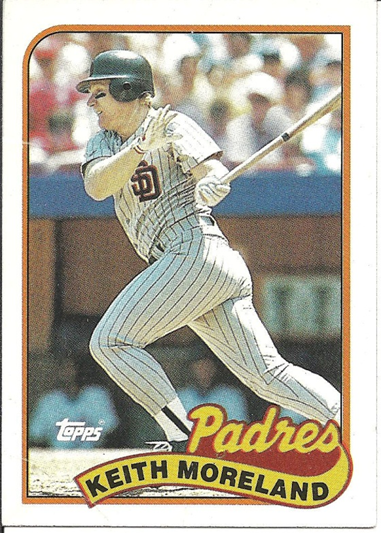
In the spring of 1974, the SMU Baseball Mustangs made the 195 mile drive to Austin to play a three game series against the University of Texas Longhorns—perennial champs of the Southwest Conference. My first experience pitching against them the previous year as a freshman in Dallas did not go well. In fact, I had helped Bobby Keith “Zonk” Moreland, then a freshman infielder for the ‘Horns, win SWC Player of the Year. Zonk never thanked me.  I relieved against Texas in the middle innings in the 1973 season, and remember little else except this: Moreland hit a poorly located slider (a pitch that may have actually hit him in the stomach if he didn’t swing) for a grand slam, over the fence, across the street, all the way to Moody Coliseum with one hop to the front of the building. Somehow the ball stayed fair, a tribute to his quick bat and his strength.  I can still see his eyes bulging out as he got maximum compression, bat-on-ball. He had the quickest hands I had ever faced (with the possible exception of Steve Volkerding, one of my high school teammates). Although all the runs scored that day were not off of me, I remember the grand slam, and a 22-5 final score. Prodigious? It was, and with a wooden bat no less. Metal bats came out the next year in 1974.   Subsequent encounters with Mr. Moreland over the next couple of years would not involve hanging sliders. Keith would later play catcher and outfield for the Phillies, Padres and the Cubs.  He is currently the voice of the Baseball Longhorns on the Longhorn Network.

moreland

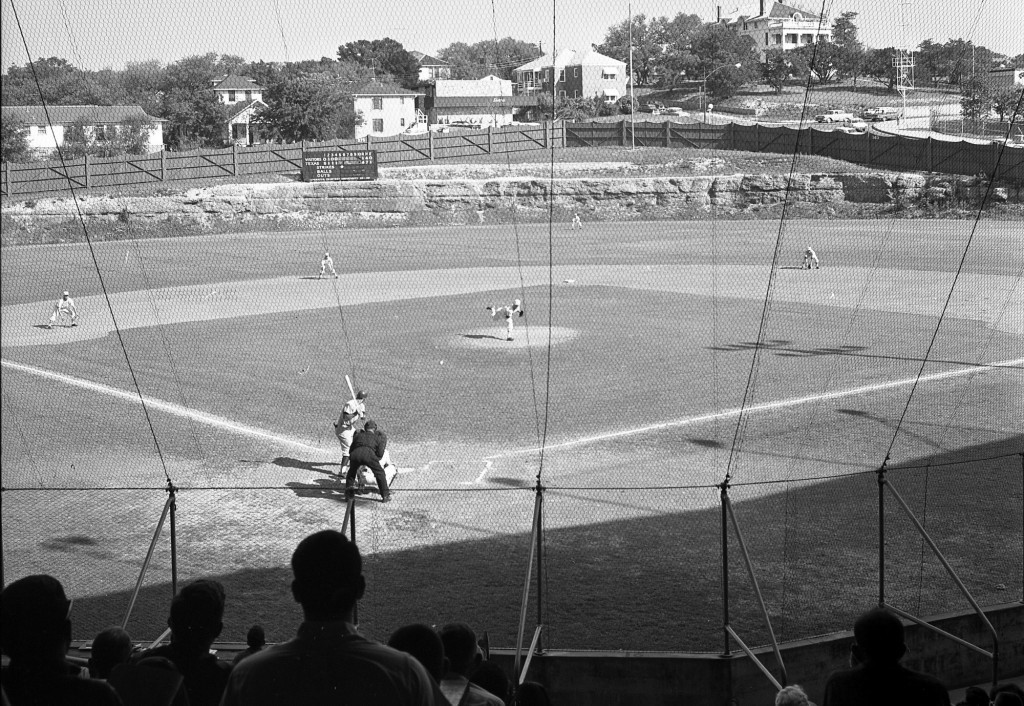
So the next year, my sophomore year, we played the ‘Horns in Austin. The Longhorns had a brand new stadium planned for their campus that opened in time for the 1975 season, but in 1974 we played them at their historic home ballpark, Clark Field. Clark Field was built in 1928, and legend has it that Lou Gehrig hit a 550 foot home run to left center there in a barnstorming game in the 30’s. The unique feature of Clark Field was its outfield configuration.

Clark2

The outfield was dominated by a limestone wall. The field may have been built on a quarry property, because this wall was about 30 feet tall in centerfield, and tapered toward left field, eventually to a small grassy sloping knoll at the left field foul line. That would have been unusual enough, I guess, but there was also a grass shelf beyond the cliff in left field, known as “Billy Goat Hill” that was in play. The fence was beyond the shelf. There was eventually a path worn near the mid-point in left center. Speedy outfielders, accustomed to the field (read home team) could gauge the flight of the ball and run up the path, and relay the ball into the infield quickly. My teammates told the story of our recently graduated star hitter Jon Astroth who had been thrown out at home on a ball he hit to the shelf two years earlier.  Here is a picture taken from an earlier year–the score shown is not an SMU-Texas score, unfortunately:

clark_field_003 copy

This 1974 version of the Longhorns would finish 54-8, and end with a College World Series berth, frustrating its primary Southwest Conference rival, Texas A&M, once again. Back then, the NCAA did not limit athletic scholarships like they do today.  A wealthy school like Texas, if they chose to do so, could afford to sign a bunch of baseball athletes and keep them on an expanded roster.  The story going around back then was that Texas offered scholarships to enough good Texas high school players each year just to create an intense competition for starting positions.  Even if some players they recruited didn’t get to play much, at least it kept those guys from competing against them.   They were a well oiled machine.

I had been pitching pretty well prior to the 1974 Longhorn series, and was at the time one of our conference starters. I had the seven inning game, the first of a double-header on Saturday.  Prior to my start, I don’t remember being nervous.  I do remember being pretty relaxed–maybe from low expectations?  The Longhorns had beaten us badly the day before 18 to 3.  I also remember being very tired for reasons that are not important to this story, but may have involved Lone Star long necks served in ice buckets consumed in a large on-campus disco called the Drum the night before. Also, why we thought it was a good idea to wear our letter jackets to the Drum, I will never know. Also, if Tino Z would have just for once kept his mouth shut….I digress.

Some games that I have played in my life are vague memories. Some, like this one, on the other hand are vivid and are preserved in my mind in more than one of my senses. I can still feel the temperature of this game on my skin, the angle of the sun at game-time, and can hear the kazoos. Yes, the kazoos. Large groups of students actually got PE class credit for coming to the games at UT, and they would distribute and play kazoos to entertain themselves between innings.

My pitching stint got off to a good start.  I was not throwing particularly hard that day, but every pitch was moving, moving a lot. I’ve had better stuff before, but somehow the ball felt unusually light in my hand that day.

Our opposing pitcher for that game would be senior Rick Burley.  We scored first, and were playing well enough to carry a 4-2 lead into the bottom of the 4th. Man, we wanted to win that game. SMU had not beaten Texas since, well, almost never. As for me, I was cruising. Sometimes when you are pitching at a lower velocity, you are instinctively more precise and careful. Meanwhile the Longhorns were overanxious and were swinging at everything. Maybe they remembered me from the year before? My fastballs were tailing away from the right-handed batters, and the lefties were getting a steady dose of curveballs.

The Longhorn leadoff batter was a guy named Terry Pyka. Pyka led the NCAA that year in bruises; that is to say, getting hit by pitches. In fact, I hit him more than once that game, one time with a ball that may have actually been on the inside corner. He had a knack for crowding the plate, and spinning away from inside pitches in such a way that his hip would sometimes stick out just a bit over the plate. He was notorious for this in the SWC. We argued about him trying to get hit intentionally, but also knew we were not going to get that call in Austin. At any rate, at the end of the 4th, the Longhorns had just a few hits, and I came off the mound after the third out pretty jazzed about everything. Pyka had been stranded on first, and he trotted over to intercept me on the way back to the dugout. Nose to nose, he calmly said these words to me now etched in my mind forever: “Lefty, you are pitching a pretty good game, but you are going to remember this as the time you almost beat Texas”. The man, besides being a great leadoff man, fashioned himself to be some kind of Nostradamus.

The game continued in the Mustangs’ favor into the bottom of the sixth.  Our lead remained 4-2, and they still hadn’t really hit the ball hard off of me. The kazoos continued their obnoxious droning, and I noticed that they were now continuing during play while we were in the field.

I was tiring, and the Horns picked up a couple of runs in the bottom of the sixth. It was now 4-4, and with the bases loaded and two outs, Finley replaced me with Jim “Hollywood” Warren. Hollywood did not throw hard, but at times he could frustrate good fastball hitters with his knuckleball and had been pitching pretty well for us in relief. He slammed the door in that inning, and we were still tied 4-4.

Jim Moffit, our right fielder was swinging a torrid bat, and put the Ponies ahead again in the top of the seventh inning with a solo homerun.  He seemed to own Jim Gideon, who had come in to pitch in relief of Burley and Robert Cuellar.  Gideon was their ace, and was scheduled to start the second game of the doubleheader.  They were going all out to win this one.  When they came to bat in the bottom of the seventh, the Longhorns suddenly quit swinging at everything and mysteriously the plate seemed to shrink right before our eyes. Hmmm. Hollywood was able to get two outs, but ultimately the bases were loaded. We just needed one more out for a 5-4 win. Just… one… out.

The next batter, Mickey Reichenbach, hit a towering fly ball into left. Our left fielder is Mark “Hambone” Hammond, probably our most sure-handed fielder and maybe the best athlete on the team. He sees the ball well off the bat and with ease retreats toward the left field foul line, intently tracking the ball all the way. That is going to stay in the park! Mark has turned back to face the infield, his eyes never leaving the ball. We have got this one. We did it. Wow. This will be one for the memory bank. This will be a game to remember on some bleak winter day, sitting at my desk in my office, when things aren’t going so well. Mark now drifts back a little more…wait…Mark’s spikes catch a tiny bit on the little grass knoll–remember the knoll? He proceeds to sit down on his backside, hard. He stabs at the ball in vain. The ball falls sadistically in fair territory just out of his reach for a walk-off two run single. A Clark Field-Billy Goat Hill single. Game over, 6-5 Longhorns.

Terry Pyka:  leadoff man and soothsayer. Not mean. Not cruel. Just dead solid correct

That One Time When I Made Terry Mead Disappear

Adult church league basketball in the early 1980’s in Cape Girardeau was a dangerous mix of frustration, testosterone, unfulfilled hoop dreams, and bad referees. It was also a mix of these two types of players:  the bona-fide players that could hope to dominate or re-live old glories, and it also had those marginal players that would be able to get the playing time they thought they deserved in high school. I was the latter.  I played for my church, Centenary Methodist Church off and on for a number of years, and lived to talk about it. The game itself was actually kind of a hybrid between traditional basketball, bumper cars and rugby. To be fair, the referees, whose only common personality trait was they couldn’t say no, were drafted off of other church league teams and were unpaid “volunteers”. Also, for some reason, they wore whistles around their necks, I’m not sure why.

This actually happened: one time, after playing nearly a half without enough fouls called to suit me, I told my teammate, Lonnie “The Ice Man” Lusk during a timeout that I was going to try to find out what it took to get a foul called in this game. I’m not particularly proud of this, but tempers were flaring on both sides, and somebody had to do something, right? When the guy I was guarding was passed the ball, I took a cartoonish run at the guy, raised up my left arm high above my head and karate chopped the guy right across the arms. As the ball bounded away, we both stopped, turned and looked to the ref, who shrugged his shoulders and indicated the out of bounds possession was ours.

One other memorable game, we played at Cape’s City Hall (the old Lorimer School), a smallish old gym that looked like it could have been in the movie Hoosiers. Our opponent that night was a south-side church loaded with ringers: Some of the guys I remember on this team were: Tony McClellon, Anthony Vinson, and most notably, Terry Mead. McClellon was a former Central High School star, and both Vinson and Mead were ex- SEMO Indian (now Redhawk) players. To say we were outmatched was a laughable understatement.

Mead in particular was a player I had admired for years since the early 1980’s. A class act all the way, Mead was a key player for Coach Ron Shumate’s early SEMO teams, just when they began reaching national prominence. He fit Shumate’s style.  Shumate recruited hungry players that were willing to hustle and play defense.  As Shumate said in his first press conference, when asked about his defensive philosophy:  “We’re going to pick them up at the airport”.  I had never met Terry, but as a fan I admired him for his hard-nosed style of play. Built like a linebacker at 6’2” he was an undersized but versatile player that was often forced to play inside against much taller forwards. He was the real deal.

Our Centenary team was hoping that the small gym would be somewhat of an equalizer, and make the contest a half-court type game more suited to our slower style of play. Wishful thinking. We did our best, but the game started fast and furious, and became a blowout early on. Our only chance had been to shoot the ball really well, which we didn’t. They owned the boards that night also. No surprise about that. We were thoroughly thrashed. I get it; they deserved to win. However, we had hoped to at least provide them with a competitive game.

Early in the second half, this happened: Terry Mead gracefully grabbed a rebound on one of our errant shots, and just as gracefully glided up the court filling the center lane on a fast break. I was the only guy on our team back on defense, retreating as quickly as I could. Terry continued to bear down on me. I made an impulsive fateful decision (not a particularly good one) when I got just inside the free throw lane. I stopped. This is where my memory gets a little fuzzy, and time starts to slow down for me. It is a phenomenon that sometimes happens when there is a real and impending danger. Ill-advised or not, I made the attempt to take a charging foul from Terry Mead while he was running toward me at full speed. I closed my eyes and braced myself for impact.

There would of course be two collisions…. the first one with Mead plowing in to me and the second, me hitting the floor. They never happened. Terry simply disappeared into thin air. Vaporized. Vanished.

When I opened my eyes, and looked up over my shoulder, there was Terry hanging from the rim. Yes, my friends, Terry Mead completely hurdled me and did ‘that nifty little shot where he forces it through the rim’. Ever the class act, and a gentleman, he did it without even riffling my hair.

The South Dallas League

Prologue

In the spring of 1977, I opted to try to put my business degree to work in Dallas. I had been talking to my best friend from SMU, Rob “Goose” Goss, who had moved back to Dallas from Chicago.  He was managing a remote retail branch of a sporting goods store called Athletic Supply. The main location was not too far from SMU’s campus on Mockingbird Lane. Goose had just rented a two bedroom apartment and had been looking for a roommate. Also, thanks to Goose, there was a (temporary) job at the main location of Athletic Supply as a floor salesman waiting for me. It was part-time employment and minimum wage, but it would tide me over until I put on the long pants and interviews were scheduled. The idea was to get into a management training program with a big Texas bank. Exuberant, optimistic, naïve, youthful….I was nothing if I wasn’t all of those back then. I was giddy with the prospects.

Sadly, with time and experience, we tend to lose this exuberance. We enjoy the cotton candy with enthusiasm, but at some point we must wash our hands in reality. It is the natural way of things, although we wish it wasn’t so. Sometimes we long to go back to a time when the possibilities were still endless.  Back to a time when we weren’t held back by fear of failure, disappointments and setbacks.  “There’s a place in the world for a gambler”, wrote Mr. Fogelberg.  Damn right. 

So, it’s 1977, and having closed my bank account at Farmers and Merchants Bank of Cape Girardeau, and with a $1,500 money order evidencing my life savings from painting houses with Mr. Hinck, I loaded up my tan over brown Landau-topped Buick Skylark, and headed to Dallas to seek fame and fortune. Fortunately for me, I found neither in this great city. It simply was not meant to be. But yes, I had some great adventures along the way.

Life of Riley

Besides having a kind of a grumpy boss, I was living an idyllic life. My work hours at Athletic Supply were from 12 noon to 6 pm Monday through Friday, and 9-12 on Saturday. My duties at work were strictly retail. Goose would come in daily to pick up inventory for the other branch store, and on Saturdays I would help him gather up what he needed. The words “May I help you find something?” were my new mantra.

I slept in often, or sometimes got up in time to go on a run through the apartment complexes.  I even bought a rod and reel, and would occasionally fish and sunbathe at nearby White Rock Lake.

There was plenty of night life those days. The apartment was almost within walking distance to Cardinal Puff’s, The Stables, Bowley and Wilson’s Alley, Stan’s Blue Note, The Time Machine—all of these were very popular SMU hangouts in those days. Nearby Greenville Avenue, just across Central Expressway from SMU, was trendy with bars and restaurants in both directions. Our apartment complex was also a popular weekend watering place for other recent SMU grads, fraternity brothers and their friends. On Sunday mornings, the area around our apartment pool often looked like a war zone: with furniture and random obscure objects often ending up in the pool. Our apartment was on the second floor and for fun we invented a “fishing” game in which we would take my rod and reel and cast down into the pool from the balcony to try to hook and pull the patio chairs out of our pool. It was an acquired skill.  On days the pool wasn’t trashed, we might fling clothes hangers into the pool for our fishing pleasure. I seem to remember that a few Coors Banquet beers may have been involved also.  The cold cruel world seemed like a mere myth in those days.

The Broncos

I had played organized baseball every summer since I was eight years old, starting with the Minor League Royals at Capaha Park in 1962. Next it was the Yankees in Little League, then the Babe Ruth League Mets, followed by Cape American Legion, and most recently with the semi-pro Cape Girardeau Capahas. This was going to be my first summer without baseball. That is, until Tommy Cansler happened to stop into Athletic Supply to look for some baseball spikes. “May I help you find something?” Soon we were bantering about baseball, and it turned out that Tommy and I had played against each other in college. Tommy had played infield for University of Texas-Arlington, and just two years before, SMU had played them in a non-conference double header. Our conversation from that point went something like this:

“So, Randy, who are you playing for this summer?”

“I am not playing—in fact, this will be the first summer that I have not played since I started playing baseball.”

“Hey, we need pitchers! My team is playing in two different leagues. One plays on Sundays in South Dallas, and the other plays in the Dallas Baseball League during the week. We have a good team, man, and all we need is some pitching. You want to play with us?”

“Sure, what do I need to do?”

Tommy handed me a slip of paper with the name “Theo” written on it, along with a phone number. “This is our coach. He is a great guy—just tell him that you know me and want to pitch for the Broncos.”

A tryout with Theo (pronounced “tay-o” as it turns out) de Hoyos was held at a high school field near downtown Dallas after work. Theo was instantly likeable, a barber by trade, and was a short stocky man with thick jet-black hair and a bushy mustache.  We warmed up, and after a short throwing session, Theo had seen enough, and signed me up. A handshake, and I was a Bronco! It is not uncommon: having some baseball skills gives you instant respect and acceptance in the baseball community. Just as we were about to leave, Tommy showed up with his friend and fellow teammate, Ricky Ramirez. We swatted bugs and talked baseball until way after dark.

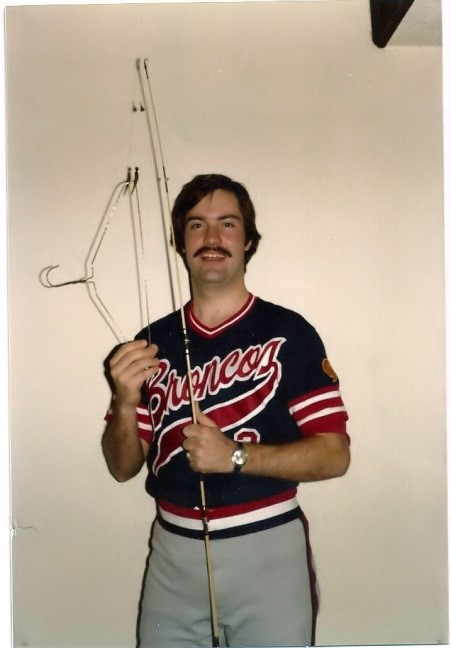
It was at our first full practice as a team that I figured out what Tommy, Ricky and Theo didn’t bother to tell me about the Broncos. They were almost exclusively a Latino team, and the Sunday league in South Dallas was a Hispanic league. My season with the Broncos would come to be one of the most enjoyable baseball experiences I have ever had. Baseball is baseball, and everything Tommy did bother to tell me was true. This team was good.

Image2

Teammates

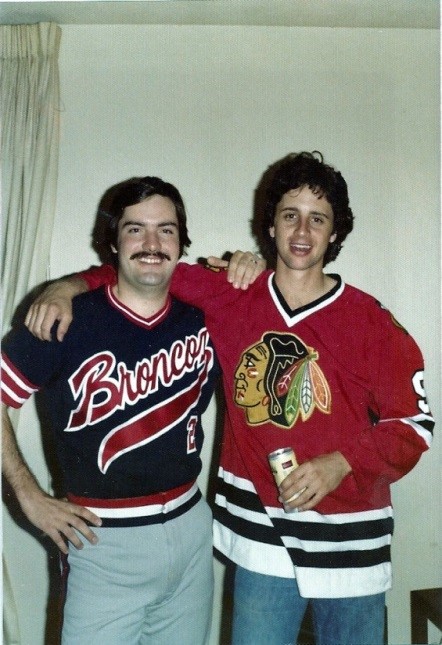
Theo was our first baseman, emergency catcher and manager. He raised enough money in the local community to outfit his Broncos in the finest uniforms I ever had the privilege to wear. The jerseys were a dark navy, heavy knitted material with red trim. Our pants were gray with the same red trim. This dark color and material choice was clearly not the best choice for the Dallas heat and humidity, in the summertime. All the jerseys had different sponsors on the back above the numbers of (at least to me) undecipherable Spanish business names. We wore “top of the line” fitted wool caps, and Theo distributed nice warm-up jackets to all the pitchers. They took their baseball seriously in South Dallas.

Our team had a mix of young players and veterans. Theo played first base and sometimes catcher with an agility that belied his short, stout physique. He also hit literally every pitcher we faced like he owned them. Tommy and Ricky had been high school teammates and had played shortstop and second base together for a number of years. They were a contrast in styles: Ricky was graceful and slick at shortstop, effortless and smooth. Tommy was gritty and scrappy and he attacked grounders as if he had a chip on his shoulder. Together they played defense with instinctive symmetry, and bantered constantly like brothers while on the field. Tommy was also dating Ricky’s younger sister. She was a knockout, by the way.

Our third baseman was a humorless guy in his late 30’s named Billy with a stellar Seleck-like mustache who looked a little rough around the edges. Billy (the only other non-Hispanic player on the Broncos besides me and Tommy) talked openly about a prior life as a heroin addict. He otherwise kept to himself, and any demons he still had seemed to be directed at umpires. He fought them constantly. Our right fielder was an aging ex-minor leaguer from the Dominican Republic named Luis Alvarez, who I was told was the best player in the league. If it wasn’t for his creaky knees, this would have been easily true. He was a pro, knew his limitations and was a very clutch hitter. It was also very cool that he knew the Alou Brothers of San Francisco Giant fame from growing up in the Dominican Republic and had played in the Minor Leagues with them. Our center fielder was a guy that everyone called “Bitche” (pronounced Beech-ay). I never knew if Bitche was his first name, his last name or his nickname. Bitche had a pencil thin mustache and long sideburns that were honed to a sharp point on his cheekbones. Bitche was fast and a good defender and base stealer. His English was probably as poor as my Spanish. We would just smile and nod at each other a lot.

The other two pitchers on the Broncos, Mario and Leico (Leek-o), were literally recruited from Mexico to play on this team. They were provided day jobs, places to stay, and most likely were in the country temporarily, just for the baseball season. Neither spoke a word of English. They could not have been more different from each other: Mario was moody; a slim 18-year-old lefty with shiny black hair down to his shoulders and an ‘attitude’.  Leico was his antithesis; a heavy-set pock-faced 40ish right-hander. Their pitching styles were just as polar-opposite; Mario was over-confident, wild, and relied too much on his fastball. Leico was careful, crafty, threw strikes and everything had a different spin. He pitched faithfully on the corners of the plate, always nibbling.

The teams in our Sunday League were: Pericos, Tecolotes, Stallions, Broncos, and the Eagles. These teams had developed into great rivals over the years. The league was very competitive without being contentious. They played hard, but the players were always respectful. In an era in which razzing and derision were so prevalent, there was none of that in this league.

Mysterious “Bench Coach”

There was another guy that was somehow associated with our team, but I have no idea how. He came to every game, sat on our bench, and seemingly interacted with no one, not even Theo. He was always dressed the same: Sun toasted leathery-skin, white cowboy hat, mirrored aviator sunglasses (day or night), toothpick, western style shirt, faded jeans and cowboy boots. He sat by himself at the end of the bench with his arms crossed on top of his oversized belly for all nine innings without talking to anyone. He did smile occasionally, revealing two shiny gold teeth, when we would win. His connection to the Broncos would remain a mystery to me, although my imagination told me he could have been a local mafioso.

“Curv-o es muy bueno”

At one point, Theo, who was constantly bragging on my curveball, asked me to show Leico and Mario how I threw it. I still chuckle about this. Here I am, right before a game, knowing only a few words of Spanish, trying to teach two guys who don’t speak English how to throw a pitch. I remember them being very attentive and nodding a lot. There were lots of gestures and demonstrations with very few words. During the course of the summer while my Spanish did not improve, I did learn that the Spanish word for curve is “curv-o”. I learned a few other words and phrases that summer: “pelota” = ball; “tecolote” = owl; “pericos” = parrots; “arriba, Bitche!” = Go to third, Bitche!; and “Sum-uh-ma Beech” = (Uh, you can figure this one out).

I was usually one of our Sunday pitchers, primarily because I could throw a decent curve. Another reason was the fact that the weekday DBL games which we played all over Dallas were sometimes hard for me to get to on time with a job that lasted until 6pm and generally bad traffic in and around Dallas. One thing I had been told early on by Theo was that the Sunday South Dallas League was a fast-ball hitting league. He also said that if I threw my curveball often, I would do well. He was right. Usually, when a batter is facing someone who throws a big hook, the strategy is to recognize the pitch early and “take”, or simply wait until they hang one. Also, when a pitcher throws a big overhand curve, it usually needs to be perfect to get an umpire to call it a strike. In this league, however, the batters swung the bats often and aggressively at all manner of pitches.

A Family Affair

Sunday games were played in Kiest Park in South Oak Cliff, a suburb of Dallas. It was a pretty long drive from my apartment, but I would crank up the tunes and head south on US 75/Central Expressway.  I think the local radio stations  must have played “Brick House” by the Commodores every 20 minutes that summer.  An hour later, I was there.

Sunday baseball at Kiest Park was an all-day family affair. The league basically took over the park. Large groups of Hispanic families would fill the park to picnic, drink beer and watch baseball. It was amateur baseball, sure, but when ballplayers would get out of their cars to walk to the diamond, the sea of people would kind of ‘part’, and shy kids would come up to us and walk us to the stadium. Their innocent reverence, however misplaced, was very touching. There were at least 400-500 people there to watch these games, no exaggeration. Lawn chairs, large colorful umbrellas, picnic tables full of food—all this despite the heat and humidity of Dallas summers. I tip my cap with genuine respect for all those families, kids, wives, girlfriends……their devotion to baseball was unmatched.

Co-League Champs

We won nearly every league game that summer. Details from these games are not a permanent part of my memory, except for one unfortunate incident while I was pitching one Sunday. A sharply hit one-hopper that I was unable to knock down or deflect hit me in a very—shall we say—“highly sensitive area of the male human anatomy” (right in the ‘nads). I was not wearing a protective cup. I eventually recovered and finished the game, but play was stopped for several long minutes while I was bent over, pale, hands on knees, studying the color of the dirt on the mound. For some reason, this whole scene was hilarious to the 500 hundred or so fans there. Must be a cultural thing, I guess. I remember that for the rest of the day, ladies were pointing, whispering to each other, and giggling at me. I just smiled and tipped my cap. What else could I do?

We kind of bounced around at .500 in the Dallas Baseball League that summer, but we fared much better in the South Dallas League. We tied for first with the Stallions during the regular season with just two losses each as I recall. The playoffs were looming, but by that time, with summer almost over, I had something else on my mind; namely, my future. Remember I said that I was going to interview for bank management training programs? I actually tried several times to get interviews by calling some of the downtown banks. My resume and my gray suit were ready to go. Each time I was referred to personnel, and the first question they had for me was: do you have an MBA? Well, each time I would explain that I had a bachelor’s degree, and each time they politely discouraged me from applying for their management training programs. OK, maybe I gave up too easily. That is probably true.

I found out that my high school friend Narvol Randol had entered the new MBA program at Southeast Missouri State University in Cape.  He said they were hungry for students and had internships available to defray costs.  A few phone calls later, I was committed. It also meant that I had to leave right away for Missouri.  I remember twinges of sadness as I hit the road and put Dallas in the rear-view mirror. I knew that there may not be another completely carefree summer quite like that one. I felt a desperate impulse to try to burn the details of this summer into my memory.

Epilogue

My return to Cape was fortuitous. In September, my friend Goose stopped in Cape on his way to his home in Chicago, and eventually to a new job in Indiana. We stopped in to the local watering hole, the Pladium, on Friday night for a beer and ran into an acquaintance from Central High School, Rita Joyce, who happened to be there with a friend. We all had a nice conversation. Well….one thing leads to another…..let’s just say it was all meant to be.

SDL2
My catch from the pool


SDL
Me and Goose. Ok, the stash is lame, but a sign of the times.

043-2-copy2

Uh, yeah………..