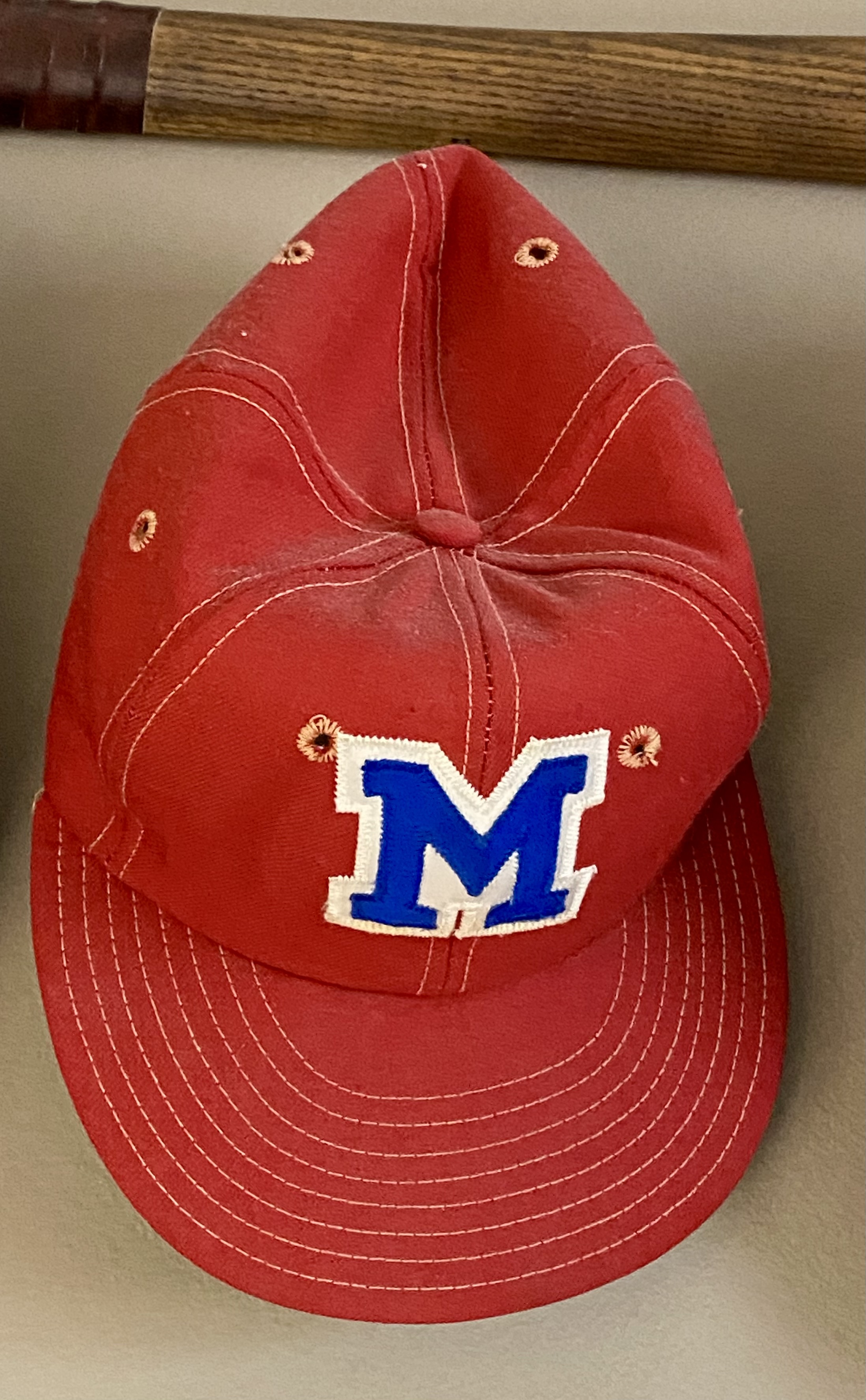
This was a song we used to sing on the SMU Mustang baseball bus as we were returning home from a loss. The title is a tribute to Coach Finley’s favorite expression (everything he didn’t like or agree with was “horseshit”), and thus became his affectionately coined nickname. I think the song originally was created by Tino Z (if this wrong I will be corrected I’m sure).
It’s catchy, a little whimsical, and all in harmless fun. We just added new verses over the course of several seasons with the hopes of leaving no one out.
Here is teammate Don “Smoke” Jarma with a perfect rendition, including some new verses from Smoke. Coach Finley always sat in the front seat next to the bus driver, and stoically never reacted one way or the other. Knowing his personality, he likely got a big kick out of it. In 1976, the number of losses in a row peaked at 22.
The view from the top of Ownby Stadium, May, 1976. Demolition had already begun.
Prologue:
Writer’s note: If you were there, this is mostly for you; here are some of my musings that may spark a synapse or two. If you were not part of this experience, please accept my indulgence, and I hope you enjoy this one as as a peek inside the Mustang baseball family.
The following paragraph in its entirety was taken verbatim from Wikipedia, 3/19/2022: Armstrong Field was a baseball park located in Dallas, Texas on the campus of Southern Methodist University located where Westcott Field now stands. It first hosted SMU football from 1915 through 1925 (Ownby Stadium opened in 1926). It was the home of the SMU baseball team (1919–1980) for many years though at least the final four seasons were played off campus. The Mustangs, Southwest Conference participants, were a team of futility during their time at Armstrong Field, scarcely in competition to win the conference. Armstrong Field did have the advantage of being located next to an outdoor school swimming pool. Legend has it that collegians would sit in the two rows at the top of the stands to see the women at the pool instead of watching the ballgame. Some were hit with foul balls due to their concentration on the women at the pool. The pool helped augment attendance by 40%. Armstrong Field was closed after the 1976 season, but before the last game the players stole home plate and concealed it in the storage area of Ownby Stadium. The plate was signed by the players and ended up in the SMU sports information division. The final four years (1977–1980) of SMU Mustangs baseball were played off campus at Reverchon Park before the baseball program was phased out.
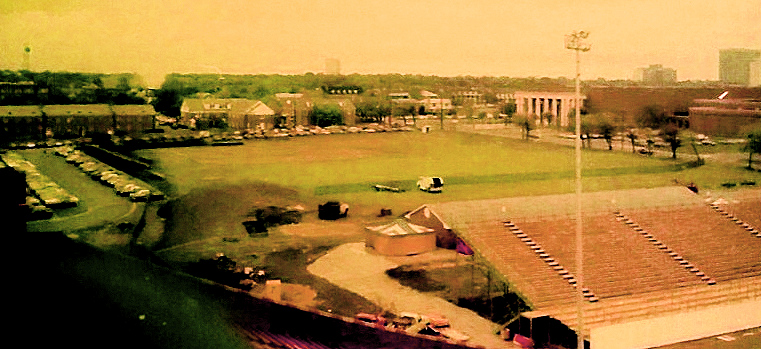
Armstrong Field, 1972.
I first saw the field in the spring of 1972 when Dad and I went to Dallas to pick up my sister Beth at the end of her freshman year. While on this SMU visit, and while Dad helped Beth pack the car, I was directed to offices in Moody Coliseum to try and meet the baseball coach. It was there that I learned his name was Bob Finley. Coach Finley was not in the offices that day, but I did learn from the Sports Information Director, Bob Condron, that the team had finished the prior season at 22-20, and that the team had a strong group of young players returning. Mr. Condron pointed out to me that right across the street from Moody Coliseum was the chain link fence representing the left field wall of Armstrong. I noticed some tattered wind screen material flapping lazily in the wind. Armstrong was located just north of Ownby Stadium (now the site of Gerald Ford Stadium) on the SMU campus, its presence incongruent and striking; its lush green and contrasting red clay dirt infield shimmered in the Dallas heat, dream-like now in my memory. I shut my eyes and tried to imagine me standing out there on the bump.
The infield itself was beautiful, immaculate, flawless. It was Garland Ridlehuber’s pride and joy. Garland was the uncle of our first baseman, Ron Ridlehuber, and he was the groundskeeper that worked on the field with a passion unparalleled. It was so beautiful that I hardly noticed the care-worn bleachers and backstop. This field would be witness to four baseball seasons of my life. Untold lazy hours of shagging balls during batting practice, including conversations with teammates both deeply philosophical and silly. As teammates we were undeniably thrown together by the fates. Challenging baseball games with tests of individual toughness. Tests that forged us in our formative years. Our record during these four years was dismal for the most part, and our challenge as I see it in the rear-view mirror, was to always continue to compete. Winning streaks were scarce. At the time I played there, the Southwest Conference was one of the strongest in the country: University of Texas, TCU, Texas A&M, Rice, University of Houston, Texas Tech, and Baylor, and SMU.
Armstrong Field now exists only in our memories. It later became a track facility, then much later added a soccer field as well.
As to memories, it remains a montage of faces, sweeping panoramic scenes, tight images, snippets of conversations and seemingly unrelated incidents that will flash through my mind when I think about Armstrong Field:
A jumble of words such as these, spoken by teammates and coaches:
“Bite me, Sagehorn!”
(She was a) “Luscious Latunia”
“That’s OK, Rookie, if you were any good, you’d be at Texas.”
”Go home, lift weights, come back next year!”
“The Greeeeen Glove”
“It was raining in Richardson, Coach”
“Whale the Wise”
“Let’s make some memories today, boys!”
“Come on, Ernie, that’s horseshit!”
“You’re brutal, Blue!”
“We gone” (CB lingo)
“Like a Bullet!”
“It’s a long way to Omaha!”
“Right on the corner, ball three!”
“Hey Pitch, your pants are falling up!”
“The Wind?!”
“I got it I got it I got it… you take it”
“You couldn’t throw out the trash!”
“Shotgun Willie sits around in his underwear”
“Man, RJ, I feel dizzy”
“Do you know Bonaparte’s Retreat?”
“I’ll be back!”
“Yeah. Hurt too, boy!”
“I only ask you to do what I ask you to do!”
“There’s a team down in Dallas, they’ve lost (insert number here) games in a row”
“Not a bad speech for an a**hole!”
Other random memories:
Pitching batting practice one sunny Friday fall afternoon to John Matetich while slightly buzzed from a Friday “TGIF” lunch at a fraternity house during my freshman year (This was not an official baseball practice. I don’t recommend it, but I actually didn’t do too badly which is scary).
When the wind was out of the south, Mrs. Baird’s Bread aroma, pleasant and strong.
Gerald Spivey’s 1000-mile stare.
Pro pitcher Steve Dunning working out with us in the early spring.
Joey Heatherton jogging on the Ownby Stadium track (yes, she looked terrific, even in sweats).
Coach Finley spitting tobacco juice on his palm and daubing it in dirt to rub up a dozen new baseballs for every game.
Garland Ridlehuber applying lime to the baselines.
Batting helmets repaired with white athletic tape.
Bushy long hair pushing out from under caps with the distinctive 1970’s “Bozo the Clown” look.
Conversations about anything and everything while shagging balls in the outfield, but mostly about women and music.
Nicknames–for everyone: Glasser, Rookie, Hubie, Snake, Whale, Smoke, Mini Whale, Stroke, Gabe, Pandy, Hambone, Billy Goat, Workhorse, Maaaj, Dud, Matty, Jonesy, Ho-art, the Green Glove, Burk, Smitty, Teddy Ballgame, Stick, Fuzzy, Shoo-bear, Congo, Tino Z, Bullet, HS, JP, Cumbo, Reddy Kilowatt, Sammy, Jake, Goose, Easy Ed, Hollywood, Geetz. A few others lost their first name permanently and completely: Beard, Hall, Landsmann, Crabtree.
“Handles” for the CB radio guys: e.g., Sagebrush, Panda Bear and Pony Express.
Whiplash from trying to follow a Keith “Zonk” Moreland laser that travelled all the way to Moody Coliseum on one bounce.
We took razzing and bench jockeying to a new level; no limits for civility, good taste and sportsmanship. It was an ugly business, but we did what we had to do.
Newly arrived football Coach Ron Meyer bumming chewing tobacco and shooting the breeze with the team in the locker room. The man oozed coolness and charisma.
Red Man, Brown Mule and Beechnut chewing tobacco—me trying these just to try to fit in and glad the habit didn’t take.
Finley getting pissed at the grass-stains on all the pitchers’ uniforms after playing a lively game of “Flip” before games.
Pitching with a lead in the fifth inning against Houston and was suddenly struck with a migraine blind spot (tried to pitch through this and it did not work out well).
Adding verses to our song, “The Horseshit Blues”.
Who literally stole home plate prior to the last game in 1976? (Pandy, your secret is safe with me, and the Statute of Limitations has long passed). We all signed it and hid it in the bowels of Ownby.
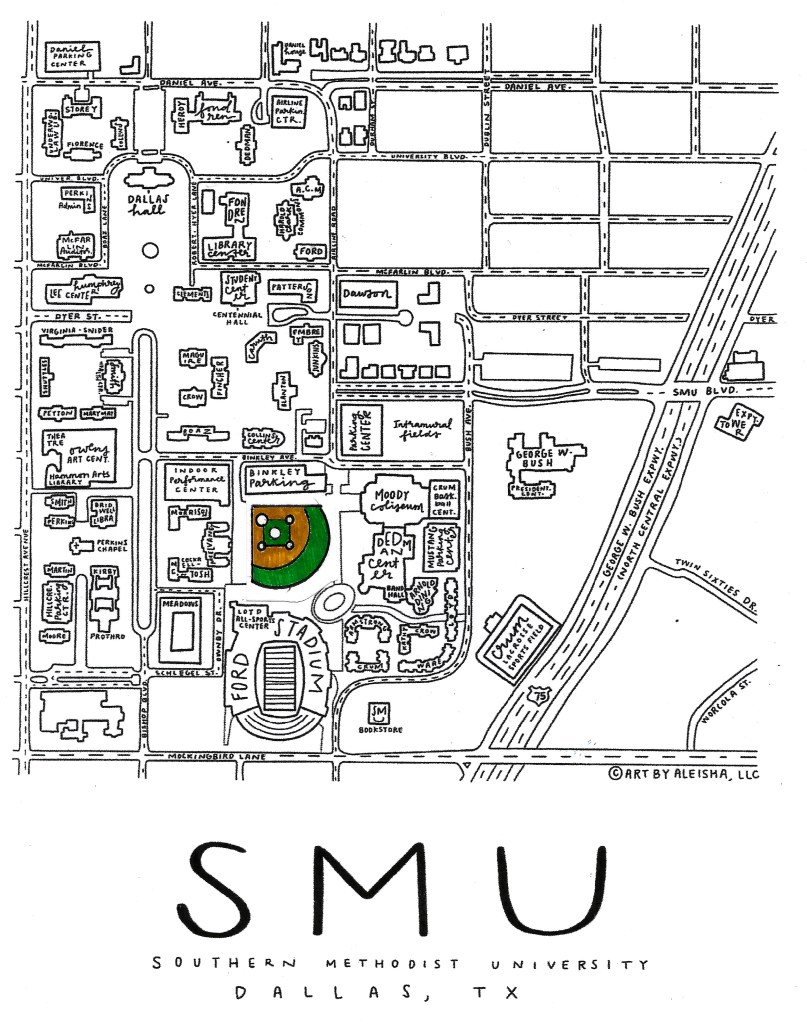
My wife, Rita found the following map/art in a gift shop in SF and bought it for me. I appreciated the gift, but felt something was missing. I called on Rita’s artistry, and asked her to add Armstrong Field in its original location. This version below hangs in my home office.
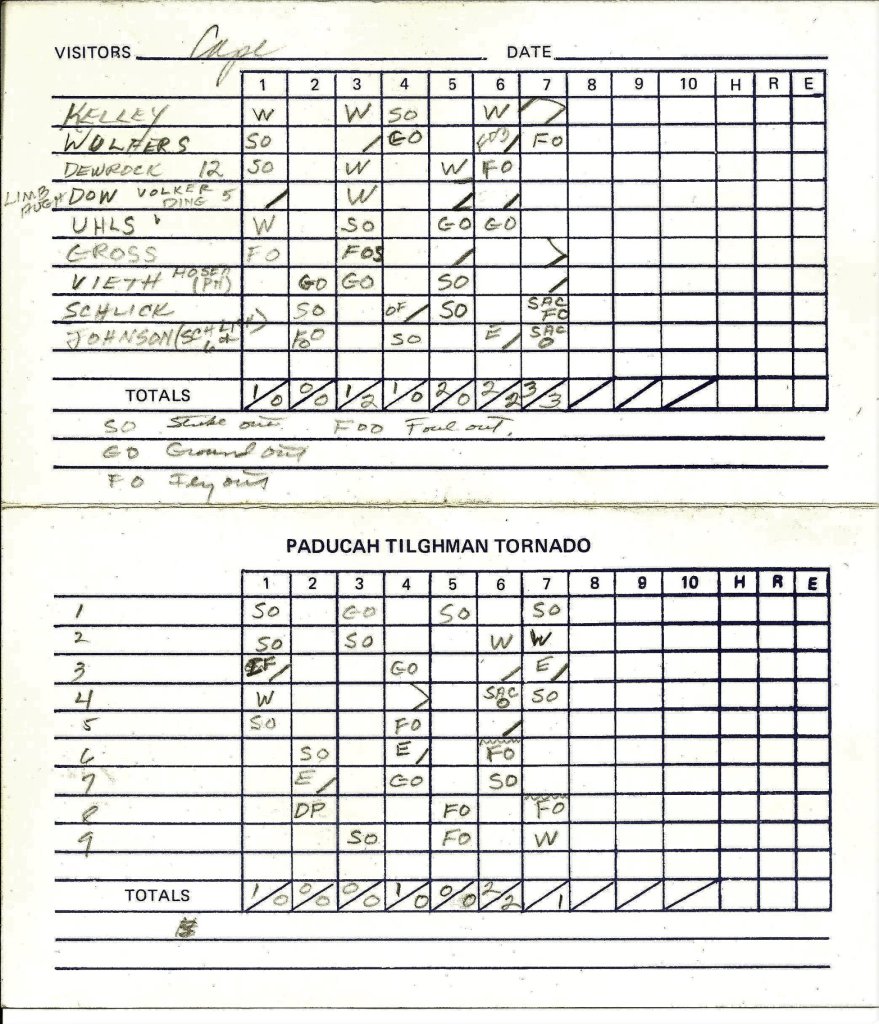
Indulge me on this one, please. This scorecard shown below is from a high school game my Junior year at Central High. That would make it the spring of 1971. It was an away game at Paducah Tilghman High. Dad surprised me with this card years later when he was cleaning out some personal files.
Here are some facts to keep in mind:
1) I didn’t even know he had traveled to this game.
2) I didn’t know he knew how to keep a scorecard. It isn’t a perfect scorecard, and you can see some symbols and abbreviations he got wrong but he did get the job done.
3) Dad was never really much of a baseball player in his youth, but was instead a solidly good tennis player. (I never beat him at tennis).
4) Dad was always supportive of Larry’s and my baseball exploits but more often than not, and true to his nature, he would quietly sneak out of work to watch from the back row or on top of the hill at Capaha.
This trip to Paducah by himself, without fanfare, was typical. Over the years, he was a witness to both triumphs and disappointments. My hero, and a rock through all of them…there I said it.
Ok, this is how it works sometimes; an incident that you witness persists in your head as a series of images. These images stir around in your memory, and are usually felt in more than one of your senses. The stronger memories become stories. The better stories can become legends. At the very least, they become little pleasant trips you take in your head. These stories don’t always have to make a point, but the truth in them, if told properly, brings clarity. Sometimes they entertain, sometimes they make you think, sometimes they touch you.
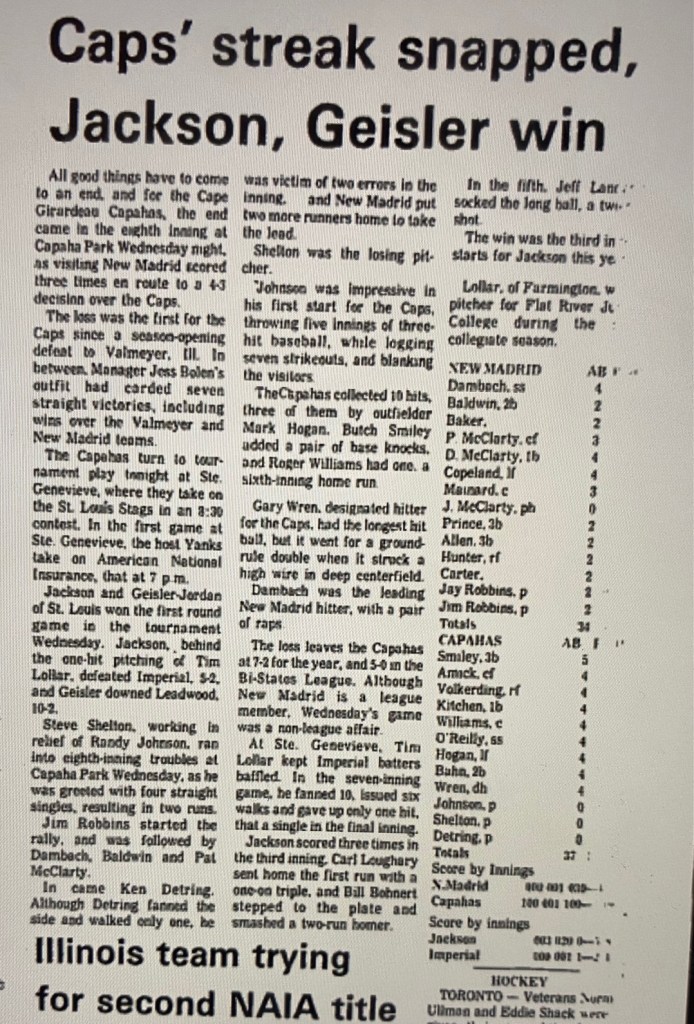
I was sitting next to Chris Bahn in the dugout at Capaha Park while the Capahas were at bat. It was a typical muggy summer night in Cape Girardeau. Our opponent that night was New Madrid, one of our Bi-State league rivals. It was an important league game that would impact the league standings. They had been much improved in recent years, with the McClarty brothers from Sikeston and Mike and Grant Dambach, brothers from Lilbourn.
That’s when this happened……
Capaha Park, 1975 or thereabouts
If you know me at all, you know that I love baseball stories. All sports can have good stories, don’t get me wrong. (Ok, maybe not long-distance running–I don’t think). I have often said that there are many ways in which baseball can touch you and imbed itself into your very being: First of, it has that perfect pace that lends itself to conversations about anything. One story begets another. Also, baseball has a very unpredictable nature. Anything can happen, and sometimes it does. It also seems to attract more than its share of “characters”. Not really sure why.
Many of you know Gary “Possum” Wren. A lifelong Cape Girardeau resident, Gary Wren was a contemporary of my older brother Larry, and played baseball with him at Cape Central. Gary was a good ballplayer and eventually ended up playing on the Capaha amateur baseball team as far back as the 1960’s. He was later convinced to come out of retirement, playing again in the mid 1970’s with me and my contemporaries. By that time, Gary had begun a solid career as a Cape Girardeau Police officer. He was also a competitive body builder of note, which also plays into this story.
So, here I was, sitting on the bench in the dugout next to Chris. Possum was at the plate. He got a pitch to his liking, and promptly caught it flush. I mean flush. The ball shot like a laser off of his bat appearing in the night sky as a cartoonish tracer of light. As I recall the image now burned into my memory, the ball appeared to actually elongate as it took off for center field on an upward plane. In fact, it appeared to be still going up as it began to leave the park in dead center between the left-center and right-center lights. Nobody was talking about exit velocity in 1975, but I would be curious to know that stat about this shot. It was simply the hardest hit baseball I could recall seeing in person.
My almost involuntary spasmatic reaction was to jump to my feet, nearly cracking my head on the dugout roof. I think I was only able to let out an unintelligent sounding, involuntary “Gyah!”.
Gary “Possum” Wren, with one swing of the bat, had toyed with the laws of physics. Also, the laws of probability, because this is what happened next: The ball’s seemingly upward trajectory was interrupted by a dull vibrating thud as it squarely struck a solitary electrical wire that was tautly strung between the light poles. Unbelievably, the ball dropped straight down from there. Alert New Madrid centerfielder Pat McClarty sprinted to the fence and caught the ball in the air. Huh? What just happened?!
Manager Jess Bolen then joined a lengthy discussion with the other manager and the umpires, including a dutiful trip from the infield out to the fence line. Possum was ultimately awarded a ground-rule double. I actually understand this. The ball never left the field. Even though the poles were outside the fence, the wire between them when you looked up at it was visibly inside the fence line. If unimpeded, the ball would have reached or possible cleared a distant Minor League backstop far beyond the fence.
I have witnessed, in person, some memorable massive home runs in my lifetime: I was there to witness Steve Volkerding win a state Legion tournament at Capaha in 1973 with a monster blast off of future big leaguer George Frazier. We were in the left center field stands for Big Mac’s 69th and 70th in 1998. Andres Galarraga once hit a ball off of some upper deck facing in left center at Busch II so hard it bounced all the way back to second base. Jon Astroth, an SMU teammate, hit a wind aided blast over the right field fence into nearby Ownby Stadium estimated at 500 feet.
I guess even though Possum’s blast was technically not a home run, I still say it’s the most memorable.
Author’s note: Others have chimed in on this one, including my good friend Chris Bahn. He confirmed that it was 1975. He also reminded me that the umpire who had to make this very tough call was Larry Kitchen, Possum’s best friend in this life. Finally, we lost the game by a single run, making it ultimately even more ironic. See the Southeast Missourian’s story of the game below:
Teammates are special. There is something magical and unexplainable about friendships forged in our common experiences that take place on the courts and on the fields. Sports like football, where tests of toughness are passed during sweaty two-a-day practices in August. Or, the common experience of running endless sprints on the basketball court after a long practice, with your lungs on fire, with your coach smugly watching his stopwatch. Or the pace of baseball that encourages long conversations about anything and everything while shagging flies in the outfield or on long bus rides late into the night. Disappointments or victories are much better when shared. You truly are impelled to trust each other.
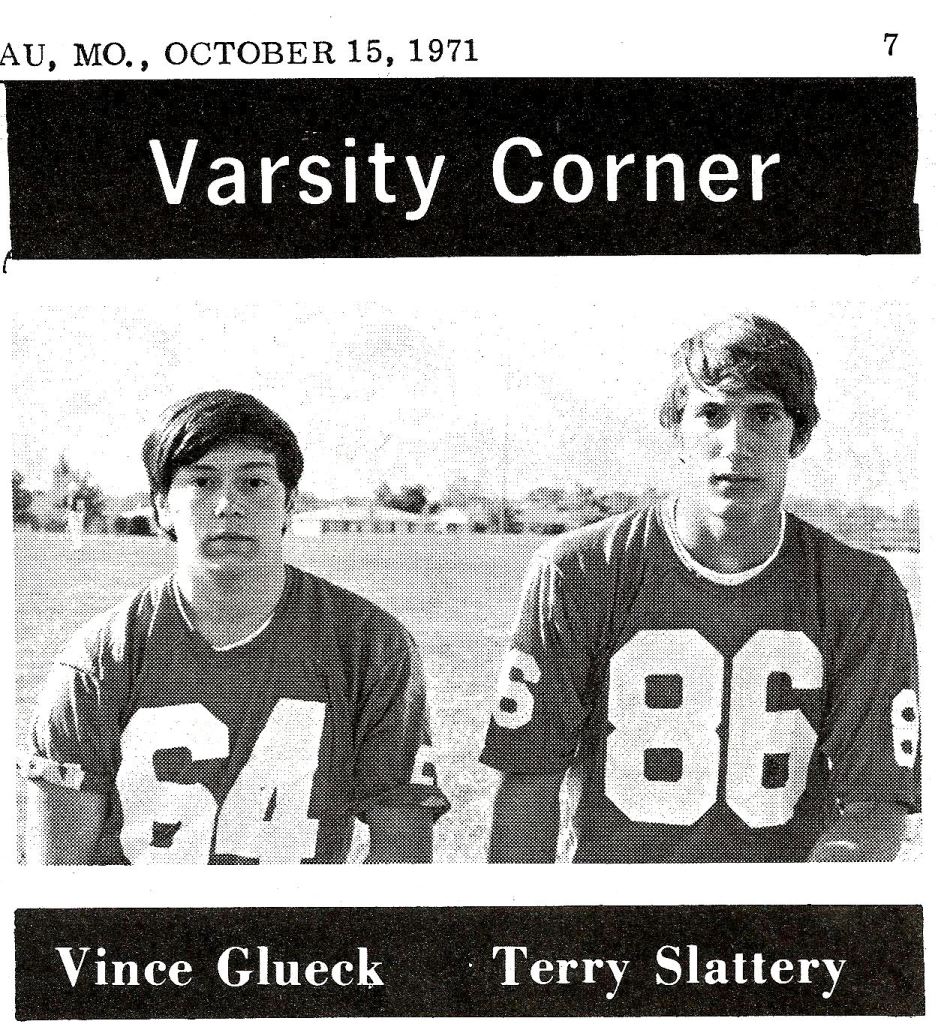
My friend and high school teammate, Terry “Slats” Slattery passed away on April 8, 2020 after a long hard battle with brain cancer. Because of all the precautions we are taking in the pandemic, many of us have been unable to properly say goodbye to our friend. There was a (delayed) memorial service on August 1, 2020 in Cape Girardeau, which I regretfully missed. Terry was a great family man, devoted husband to Annette, and raised two fine sons, Patrick and Blake.
As many of you know, Terry was long-time manager/owner of Howard’s Sporting Goods in Cape Girardeau. His soft-spoken nature and welcoming personality made this an outstanding fit-perfect, really. His wit was stealthy and razor sharp. After our family moved away from Cape for the second time in 1998, his presence at Howard’s became an important touchstone for me when returning to Cape in the ensuing years. By that I mean as you naturally grow more distant from even your closest friends as the years pass, it becomes harder and harder to keep those friendships close and tight. Wish it wasn’t so. Unless you have ever had to move away from your home town, this may be hard to understand.
But Terry was always there. Howard’s was the epicenter of local sports for several generations. I would make it a point to swing by Howard’s on many of my trips to Cape. Here, Terry would always greet me warmly, and we could casually discuss the latest local news (mostly Central High and Southeast sports). Terry was one of those rare individuals that could give you these updates (OK, gossip included!), and stay true to his kind nature, which meant he was never critical of anyone, whether deserving or not.
Slats was a fellow 1972 CHS grad, and football teammate. He was an outstanding, albeit under-utilized tight end with deceptive speed. Terry didn’t really run, he glided. His effortless, smooth running style was a gift, and he never looked like he was trying all that hard, but you knew he was. One game in particular comes to mind that happened in our senior year.
We had beaten Festus in game one, and were facing the Carbondale Terriers in game two. At the time, I was the starting QB, and we were tied 0-0 late in the first half on our own 20-yard line, when I called a bootleg pass called the 46 Blast Pass. This play was a fake of one of our most often-used off tackle running plays. When it worked, the tight end would get behind the defenders on a deep post pattern. I faked to the tailback, put the ball on my hip and trotted back, looking over my left shoulder. I looked up, and there was Terry, streaking down the middle of the field, with no Terrier within twenty yards of him. In my excitement, I almost blew it. I pulled up short, spun to my left, and threw a hurried, adrenalin-inspired, flat, fluttering pass “in Terry’s direction”. It was by definition, a ‘catchable ball’, but only because Terry was somehow able to catch it. He stopped in full stride, reached down and plucked the ball headed for his ankles, and streaked down the field ahead of the defenders. I can picture it so vividly in my head as if it happened 5 minutes ago. It may be one of the ugliest 80 yard touchdown passes in history. We would go on to win 28-0, and Slats caught another TD pass (this one was prettier) from me later in the game. It was my best football game, and Terry played a large role.
This was a good day, a special one that Terry and I would on occasion have a good chuckle about. Thanks, Slats for this memory, and for all those other times. That (fall) 1971 season would turn out to be an outstanding one for Central (8-1), but a personal disappointment for me, in general. A story for a different time.
Terry would go on to an outstanding career at Southeast as a clutch receiver, catching passes for the (then) Indians. We lost a good one, folks. Slats was a class act all the way, and done too soon.
Writer’s note: This story was better told by its participants, especially Jim Moffet.
Mark Hammond, OF from Port Arthur, Class of 1975.
Our SMU baseball team in the mid 1970’s always had several players that had gravitated from the football program. Mark “Hambone” Hammond was one of them. Fun-loving, upbeat and energetic, he was one of those great teammates you really enjoyed being around. Recruited as a wide receiver, Mark was athletic, tough, and played all-out. He had great instincts and played defense with intensity and pride. His uniform always seemed to be dirty. There are many stories I could recall about his exploits, but here is my favorite “Hambone” story:
During those years I played at SMU, the baseball team rarely used strategy. Our offense was old school and generally not very creative. Coach Finley liked his players to swing the bat aggressively and hit the ball hard. Maybe the rarest strategy for us was the “suicide” squeeze bunt. This play requires the baserunner on third base to break hard for home plate early as the pitch is being thrown, and the batter then attempts to bunt the ball on the ground anywhere in fair territory. It is an exciting play when it works, and any easy out when it doesn’t. Also, everyone involved has to be on the same page, and must pay attention to the signals putting the play “on”.
When we did attempt the suicide squeeze, our signals worked like this: the third base coach gives a visual signal to the batter, maybe a series of hand gestures. Next he gives a stealthy audible signal to the runner on third–primarily because the runner naturally has his back to the third base coach, watching the pitcher holding the ball. Our audible (spoken) signal to the base runner on third was to say anything about the weather. Both the runner and the batter must then give a predetermined stealthy signal back to the coach to ensure both had the signal right. Our return confirmations signal was putting your right hand on the top of your helmet. This would most importantly keep the batter from swinging away while the runner was bearing down on home plate, completely exposed and vulnerable.
Ok, so Jim Moffet is coaching third base, and Mark leads off the inning with a standup triple. Completely out of character, Coach Finley gets the idea to try the seldom used suicide squeeze play, and after getting Moffet’s attention, relays the suicide squeeze signal in to Moffet. Uh oh. The problem? There was not a cloud in that big blue Texas sky.
Moffet first signaled the batter, and then proceeds to say these words to Mark, who is standing a few feet away, intently watching the pitcher and getting ready to take his lead down the third-base line:
“Boy, that wind sure is blowing today”.
Nothing. No acknowledgement from Mark. Our hitter, seeing no confirmation from Mark, steps out of the box to stall for time.
A little louder: “I said that WIND sure is blowing out there today!”
Still, nothing. Finally Moffet says loudly: “Hey Mark! The WIND is REALLY blowing today!!!”
Mark jumps as if somewhat startled, and whirls around wide-eyed and says, “THE WIND?!”
Moffet nods gravely and very deliberately says, “THE WIND!”
Mark touches his helmet excitedly to acknowledge the squeeze and quickly takes his lead.
It’s funny, but I remember this incident up to this point in amazing detail, but could not tell you if that particular attempt at a squeeze play was successful.
A little aside: Mark’s older brother Gary played football at SMU, and had the unprecedented distinction of earning all-Southwest Conference at three different positions. As a sophomore, Gary stepped into the void left by Jerry Levias at wide receiver and was a favorite target for prolific SMU senior quarterback Chuck Hixson. As a junior, to get Gary more ‘touches’ with the football, Coach Hayden Frey inserted him at half-back. Finally, as a senior, due to injuries to several teammates, he inherited the QB position kind of by default. Each year he rose to the occasion and excelled. In fact, I saw Gary at QB lead the Mustangs to victory against Mizzou in the fall of 1971 in Columbia, MO. He ran the option flawlessly and was elusive, darting inside and outside, completely frustrating the Mizzou defense. Gary used his versatility in the NFL as a receiver/punt returner for the St. Louis Football Cardinals and the New York Jets in the 1970’s.He was recently inducted into the SWC Hall of Fame.
Our family vacation to Holiday Homes in Pensacola, FL in 1960. The McGintys, the Johnsons and the Nunnalees spent a week at this classic resort on the Gulf.
It had gotten nearly dark as I was striding to the plate in my Cleveland Indians uniform. It was muggy, and the lights were a little dim here in Lamar Porter Stadium in south central Little Rock. Lamar Porter Field had a classic look with stands of concrete, painted dark green, built during the Great Depression as a WPA project.Brooks Robinson had played his American Legion baseball there. The rest of the scene was a little dream-like. The nearly empty bleachers were eerily quiet and deep in the shadows. The occasional chatter briefly echoed and sounded hollow before fading away. The grass was glistening from the dew. A bit of fog out amongst the trees in the outfield added a touch of mystery.
We were playing the Rangers, a team that was very close to ours in the standings. Their pitcher was pretty good, but we were starting to get to him. He was a lefty about 6’6″ and he handled himself as if he had played somewhere at a pretty high level. We needed a rally. Two on, and two out. Al, our best hitter and RBI producer, was on deck and I needed to keep the inning going. He started me off with a curveball-a pretty good one, a pitch I was not expecting. I hacked at it and missed, cussing under my breath. Come on, I thought. You are 34 years old and playing baseball again. Have some fun!
I stepped out of the box and asked Al for the rosin bag. Knocking the bag on my wrists and on the handle of the bat, I winked at Al.A rush of memory washed over me, reminding me (again) how much I loved this game, now infused into my very essence.
The next pitch was a fastball middle in, and I turned on it. Ping! It took off like a shot into the gap in left center, disappearing into the darkening sky. “HEL-LO!” said Al, as I took off for first. I ended up with a stand-up double.
It’s hard to describe in words that feeling when you put a good swing on a ball and hit it right in the sweet spot, but I will try….. you feel a subtle chord strum, a pleasant harmonious vibrationfrom your fingertips to your toes.You ballplayers know what I mean.
Arkansas, 1990
We were living in Arkansas in 1990. Back then it was all about the possibilities. At 34, I was the youngest bank president in Arkansas, running the first de novo (start-up) bank in Little Rock in 20 years. The local banks with their high powered law firms had tried to keep us out of LR for almost 2 years by filing objection after objection to our charter application. We eventually were able to open, but not without some local political clout. Two can play that game. Another story for another time.
I was in my office chatting with my friend Rick Johnson (no relation), the son of one of our bank directors when the subject of baseball came up. Rick was talking about hurting his knee in a slide the night before.
“You are old enough to know better”, I chided.
“I know, but playing baseball gets me excited, and I can’t help myself sometimes.”
“Baseball?” My ears perked up.
It turns out that there was a new game in town. Rick explained that the Central Arkansas League, part of a relatively new national organization called the Men’s Senior Baseball League, or MSBL, had been playing baseball in the area for a couple of years. The minimum age for the league was 30 years old with no maximum. I did not know this league existed.
“Do you play?” asked Rick.
“I used to, but I retired about 7 years ago”. Little did I know, that would be only the first of many retirements.
After some more discussions and negotiations, Rick put my name in with the league steering committee and I was assigned to the Indians. Rick was on the Dodgers. There were eight teams in the league, and we all wore genuine replica uniforms of Major League baseball. The class of the league was a team called the Astros. The Astros had dominated the league since its inception. It sometimes happens in leagues like this: one reason was that the Astros, once they were champs, usually had a number of players each year that wanted to jump to their team. In other words, if you can’t beat ’em, join ’em. The Astros were able to pick and choose from this group. They also seemed to get all the best new star players moving to Little Rock in the offseason, through some kind of ‘hush-hush-smoke-filled-bar-room-chicanery’. Team reps of the other teams would grumble, but nothing seemed to change.
Our team was competitive enough, and I really enjoyed playing baseball again. The league was thriving by drawing players from all over the central Arkansas. We even had a pitcher named Ed, aged 56 that drove from Memphis for our games. Apparently his Memphis team wasn’t giving him enough innings to suit him. Ed was old enough to be most of our Dads. His stuff was slow, but he threw strikes and would sometimes give good hitters fits by throwing them off balance. Other times, he would just get shelled. Either way, this guy was unflappable and wanted the ball, earning great respect from all of us. I have to laugh about this issue of age now. At the time, I had no idea that I would continue to play well beyond that age in St. Louis!
In my first season, our Indians finished in the middle of the pack, and lost all of our games against the dreaded Astros. The pitching staff of the Astros was deep, and they rotated guys in regularly. Most other teams were short of pitching depth, and the hurlers would usually run out of gas late in games.
Life was getting complicated. Our little bank had to weather a flood of marginal customers sent packing from the other banks. We expected it, but it still took a lot of time. No banker’s hours in a new start-up; We had a small but dedicated staff, and we asked a lot of them. For that reason, I liked being the last to leave at the end of the day.
In August of 1990, Desert Storm would call my brother Larry to the other side of the world with his AWACS squadron charged with directing air attack traffic. I could not get enough news about Desert Storm. The internet was in its infancy, and I remember subscribing to IBM’s Prodigy service just to get my war news at night. Rita had her hands full with three young kids and a new city to learn. Two of our kids were in youth sports. I learned again what I already knew and would never forget: don’t ever underestimate this beautiful determined woman/mom/wife. All this to say that playing baseball in the senior leagues was a genuine refuge for me from this complicated life.
For the 1991 season, our Indians had very little turnover. We did have one defector, however. One of our best all-around athletes jumped to the Astros. Jerks. We did get two replacement players, however. One was an infielder named Gene who moved from Phoenix. He was a versatile player whose claim to fame was that he was an extra on the set of the movie Major League. I looked for him in the credits, and sure enough he is there. He said that the director picked him because he could throw a curveball consistently for strikes. He was a stunt double for Chelcie Ross, as Eddie Harris, the guy that threw curveballs to Dennis Haysbert’s character Cerano in spring training. He said the filming took all day and his elbow was killing him at the end. The price of fame!
The other guy we picked up said he was a pitcher. His name was Mick Shade. Not making that up. Possibly the coolest baseball name I have ever heard. Apparently this guy was an unknown quantity to everyone. He showed up to Lamar Porter Field for our first game, and William, our manager, threw him into action by starting him. I remember bits and pieces of his performance. Here are a few vivid facts that I do remember, in no particular order. He threw extremely hard. He threw mostly fastballs and hard sliders. He struck out 16 batters in nine innings, and gave up two harmless singles. We won 3-0. This guy was legit.
Finally, we found a pitcher that could beat the Astros! Woohoo! After the game, we spent some time kicking back in the dugout at Lamar Porter talking baseball with Mr. Shade. We learned that Mick Shade was a former Cardinal farmhand, and had pitched as high as AAA in their farm system, and had been out of baseball just a couple of years.
That was the last time any of us ever saw him. Mick Shade disappeared like a fart in the wind, never to be heard from again. We were left to ponder his fate. Did he get hit by a truck? Did his agent suddenly hear about a job opening in Visalia in D ball? Did he throw his arm out in the first game? Did he decide that our little senior league was not worthy? Did he suddenly find a need for the witness protection program? Was he real? I half expected him to mysteriously show up in an Astros uniform, but he never did. The mystery of Mick Shade was never solved.
I have been a participant in baseball most of my life-even up until a few years ago in a 60+ senior league. I often say, I am currently in my seventh retirement as a player, most recently in 2016. My love for the game is in the details, the way I still get a boost from things like gripping a baseball, and the simple pleasure of throwing it and watching it go where it was intended to go. Connecting while batting with little or no vibration right on the sweet spot works, too.
My introduction to baseball was from watching my brother, Larry. He was very good, and I wanted desperately to be as good. Mom could testify to my dedication. I would spend nearly every summer morning throwing a hard rubber baseball against our brick garage: THUMP…… THUMP ….THUMP… early and often. I would literally spend hours creating scenarios of real game situations, and acting them out. I eventually wore those practice balls smooth. All that racket had to drive Mom crazy, although she never complained to me.
Many thanks to the coaches that showed me some of the tricks of the pitching trade. Larry, of course, taught me to throw my first curveball. My early efforts at a curveball resulted in a big side-arm roundhouse pitch that I would sling, mostly for show as it turns out, but I could throw it for strikes. Batters rarely even swung at it. The key to my game then (and later, come to think of it) was winning over umpires. Hall of Famer Greg Maddux turned that into an art form.
Terry Ashby, my manager on the Mets in Babe Ruth League gave me my first chance to really learn how to pitch, by throwing me out there at age 13 against 15 year old players, and leaving me out there to work things out for myself on the mound. Many of you know T.A. His baseball pedigree is unquestioned, and his upbeat attitude and demeanor helped me immeasurably to get through some very tough games.
One time pitching for the Mets against the Braves, I was cruising. I had a shutout and a big lead until late in the game when I became my own worst enemy by becoming inexplicably wild. I eventually allowed the Braves to come back, and then to take the lead. It was hot, and I felt tired and thirsty, and I remember wanting to quit. My body language must have been pitiful. I had noticed that T.A. was visibly frustrated, pacing the dugout and he finally came out for a mound visit. I started to hand him the ball thinking he was taking me out. Instead, our conversation went a different way. He said that no, he was not there to take me out. He next told me that I was the reason we would likely lose this game. That was the truth, unvarnished. He then told me that in situations like this, I needed to reach back for something extra and learn how to finish and win games like this when you are not your best. Finally he said these words, burned into my memory forever: “I want you to always remember this game, this conversation, and these (bad, defeatist) feelings you’re having.” Thanks for this, my friend. I do remember. Terry thought enough of me to want me to be better. I have never been one for excuses since.
It was Central High School Coach Dale Meier, however, who showed me all the technical things to maximize the effectiveness of my pitches. Things like: winding-up in control, settling on one arm slot for all my pitches, finding a balance point to keep my body in control, how to throw a slider, how to use finger placement to maximize use of baseball seams for a variety of pitches and finally, pitching strategy. The benefits of having an ex-pro baseball pitcher as a pitching coach are obvious. Most importantly, however, he was charismatic, a great teacher who treated us with respect. He was patient with this young lefthander wanting to get better. My senior year in high school was my best, and Dale is the reason. I was having a very tough year for reasons unrelated to baseball, and simply put, his confidence gave me my much needed redemption. Dale’s influence with the Cardinals resulted in me getting scouted in a game we won at Fox High School. When I told him I was set on going to college, he worked hard, successfully, to get me a baseball scholarship offer to play for Hi Simmons and Gene McArtor at Mizzou. I was eventually encouraged by others to go south if I really wanted to play college ball, and walked on at Southern Methodist, then in the old Southwest Conference.
Toward the end of my senior high school season, we faced the Jackson High School Indians in the finals of the sub-districts at Capaha. We had already beaten them earlier that year: fellow lefty and senior Bob Garner had shut them out at Jackson, 4-0. Bob would finish the season with a perfect 0.00 era in 24-plus innings in four starts. Playing them at Capaha would give us an advantage, but we knew this was a scrappy bunch of athletes from playing them in football that year.
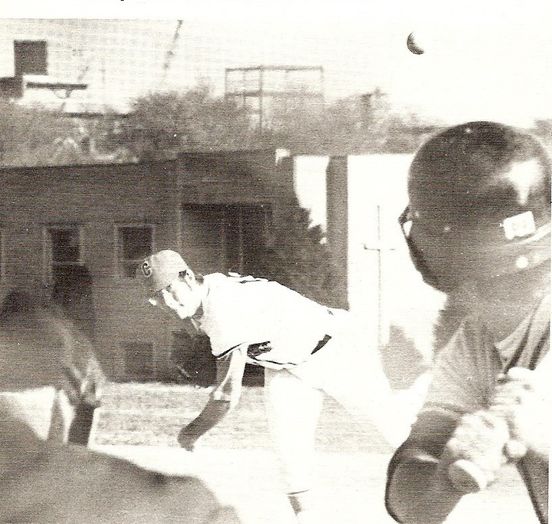
I pitched OK, not great. It was a damp, cool overcast day, and the ball felt very heavy. I found myself pitching into and out of jams the whole game. Indian outfielder Dave Riney seemed to me to be on base every inning, but he couldn’t be, could he? Jackson’s pitcher, Terry Bazzell, was very good that day, and of course he was pitching in the same lousy conditions. The game was a nail biter; we were tied 2-2 going into the seventh (last) inning. In the top of the inning, Jackson loaded the bases with two outs. My elbow was chirping at me, and my grip on the baseball was becoming weaker by the pitch. The ball got even heavier. Reach back for something extra when you are not at your best, TA had said. The count went to 3-2, and the hitter fouled off the next three straight pitches, all strikes, all fastballs. I took another deep breath, knowing a ball was a run and a possible loss. The next pitch was a borderline pitch, but too close to take and thankfully, the ump, Roger Williams, thought the same and called him out.
I left the field in a rush of adrenaline, and Coach Meier met me on the way to the dugout. He was not one to do that, and he kind of caught me off guard. He looked me dead in the eye, and asked me if I was tired. My first response: be truthful. I said “yes, but I’m ok to pitch. I want to finish this.” Apparently, my tired eyes betrayed my words. I was toast. He knew it. I knew it. The Jackson Indians knew it. He took me out. We would go on to lose 3-2 in extra innings. As noted before, no excuses, and no one’s fault, it was just Terry Bazzell’s day. Terry would go on to pitch for SEMO and the Capahas and become a long-time HS coach in Hannibal, MO.
All of this to point out some things I have learned from baseball. Things like learning from mistakes, and doing your best even when you aren’t playing well. Things like throwing off discouragement, and bouncing back from defeat. Finally, a thing like learning to be coachable. I have been blessed by excellent coaches, especially in my youth.
We were living in Little Rock, Arkansas in 1990, and were busy establishing ourselves as a baseball family. I had just joined an “over thirty” baseball league called the Central Arkansas Men’s Senior Baseball League. Allison was in her first softball season, and my son Casey played for his first real team in an organized league. Suzanne was just a toddler. Casey was just four, turning five in July, although we had been working on his skills, basically since…..well, since he was able to stand upright. He was already showing an uncanny appreciation for the game, including a memorable visit at 9 months old to a Cardinal game at Busch Stadium II in which he intently watched the entire game, mesmerized, and seemed to have an understanding of the game way beyond his age…perhaps through the passing on of DNA from me? Did he somehow know that he would eventually get to play baseball on this very field? That remains a sweet mystery.
Busch II
In the summer of 1990, Casey was invited to play on a co-ed team coached by Joe Perez, a good friend from our church whose daughter, Laine also played. A few years down the road our daughter number three would be named Laine also. Joe was a great guy, kind and supportive, perfect for this level of baseball. I remember the first day of practice, he was patiently showing some of the girls and boys how to grip the bat, and cheering every swing (hit or miss) by the players. Most of those first hits off the tee amounted to swinging bunts. When Casey finally got to bat, his first swing resulted in a sizzling line drive right at Joe’s head that fortunately missed him as he ducked. Joe was amazed that this skinny little kid could generate that much power. Of course, yes, I was proud yet relieved Casey didn’t break Joe’s glasses.
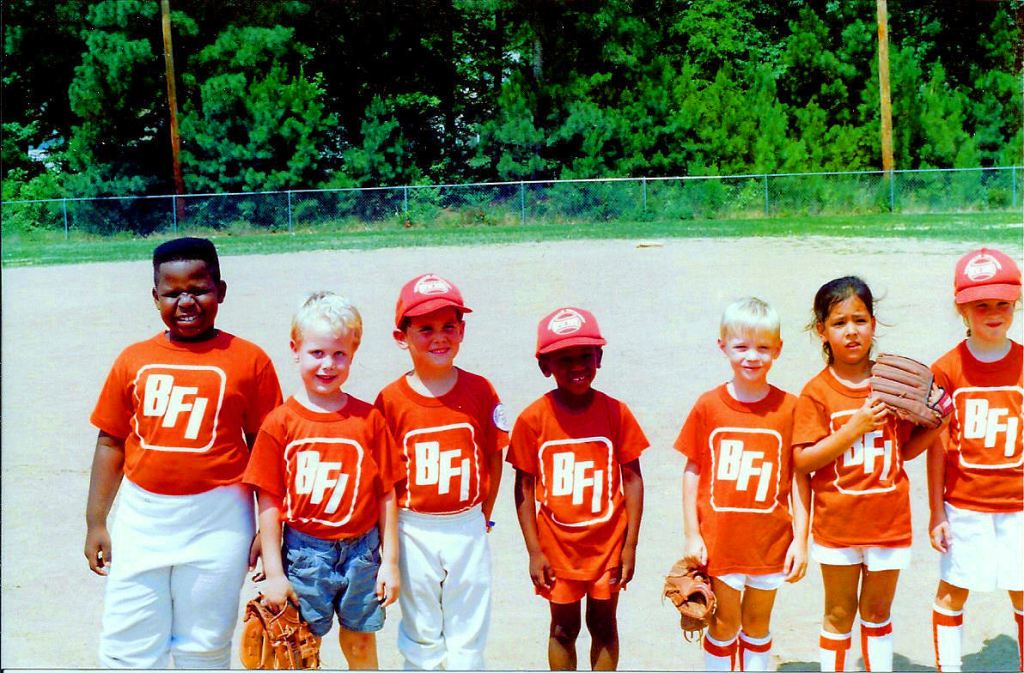
The team was rag-tag at best, but enthusiastic. It was sponsored by BFI Waste Management, which was a classic, rivaling “Chico’s Bail Bonds” as a sponsor. Just the sight of those orange tee shirts in pictures makes me smile.
Mighty BFI; Casey is third from the right.
The league in West Little Rock was a hybrid of “coaches pitch” and T-ball. By that I mean you got two legit swings at a ball tossed underhand by your coach, but if you missed both, the tee was quickly brought out for a third “swing of shame”, just so the kid could feel a little better about his or her at-bat and hopefully not miss the ball sitting on the tee. You could actually strike out, however if you missed on that third swing.
Defensive strategy was “baseball-ish“. Players would line up behind a chalk line about 25-30 feet from home plate, and most outs were made at first by scooping up the ball and racing with the batter to first base. Coach Joe initially tried to get our players to field balls and try to throw to a first baseman, but after a game or two of not getting anyone out, our team devolved into the ‘Race to the Base’ defense like everyone else. There was a max run-rule of 5 per inning, and it was made clear that the league didn’t officially keep score in games, and thus there were no official winners or losers, which we constantly reinforced to our kids. Of course, this didn’t stop the parents of the better teams from doing just that-scorekeeping.
One team, sponsored by a local bank, was loaded. Credible rumors were going around that they were actually recruiting players. They were routinely scoring the maximum runs per inning and shutting out their opponents. When we played them, we were shut-out 20-0. Their kids were taking extra bases unnecessarily, cheered on rabidly by their coaches. They played their best players on the front line on defense the whole game. OK, but really? We only had a couple players get to second base the whole game. I was very relieved when the game ended, as it was painful to watch. When Casey went to get in line for his customary free Icee, he came back with a troubled, puzzled look on his face. Our conversation went just like this:
“What’s wrong, Casey?”
“That boy over there said we lost!”
I used to say that the main goal of youth baseball should be to create a love for the game that will result in the kid wanting to come back next year. Mission accomplished in 1990 and subsequent years on this goal. Casey would end up with a scholarship in baseball to a D1 college and continues to teach pitching and hitting lessons on the side. And yes, he played at Busch Stadium II as a senior at Eureka High School.
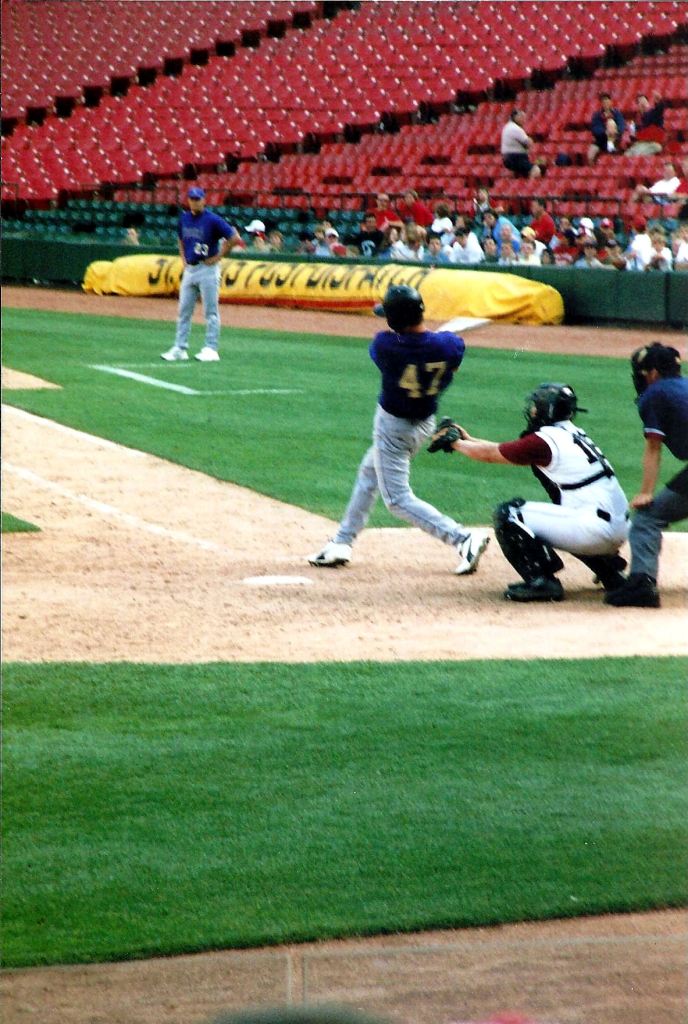
Casey and his high school Eureka Wildcats playing an exhibition in Busch Stadium II in 2004
Final thought. I never wanted Casey to base his self esteem on wins or losses that his team experienced. I admit that I have roughed myself up a few times in my lifetime playing team sports with that futile and illogical concept. So, the question I always asked Casey after the game:






 Little stories from the big adventure